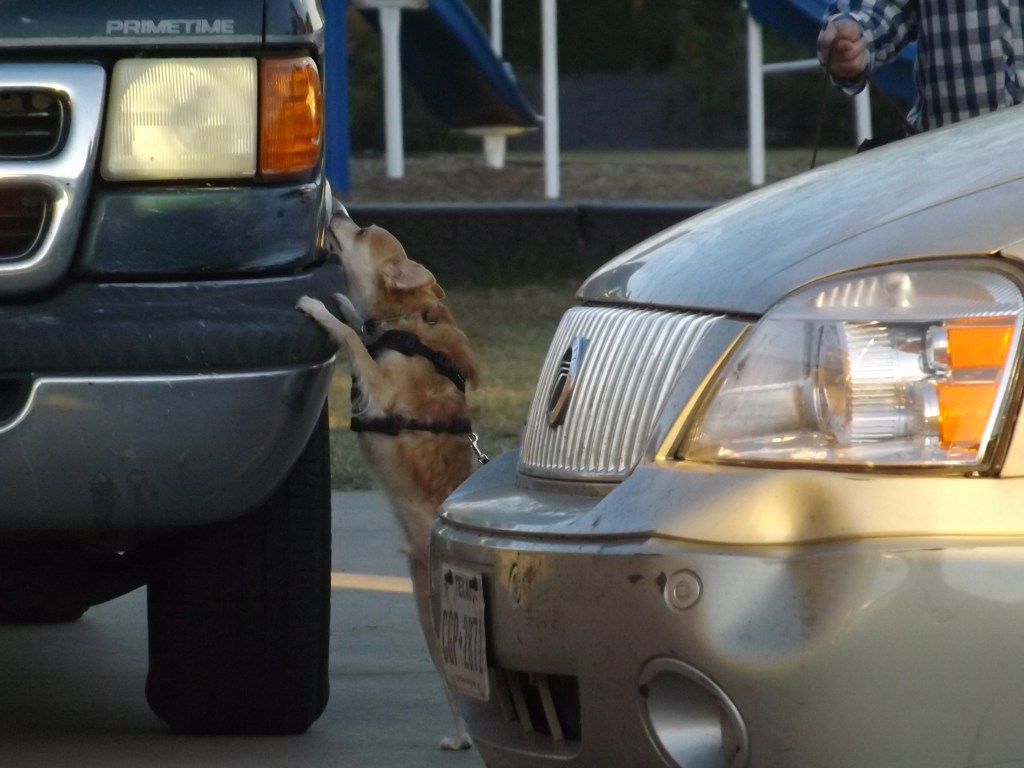
I have been doing some coaching for the upcoming AKC Master Scent Work competition, and a handling issue has come up with a couple of my students. This handling mistake is subtle and it’s a trap that even experienced handlers fall into. I call it the feedback loop, and it happens when the dog and handler start influencing each other and end up false alerting.
I have seen this loop happening many, many times—Here’s an example:
I was timing exteriors at an NACSW trial, and we were in a big inner courtyard in a school. One of the competitors was a friend of mine with her little mixed breed terrier dog, very experienced dog who was a savvy hunter. They had a good start from the start line and I could see Pie casting about for odor. Unbeknownst to the competitors, (as is possible but not guaranteed at an NW3) the area had no hides in it. The challenge, of course, is to see if the team will recognize a blank area. Pie wasn’t getting any odor, and I could tell he was a bit puzzled.
Then I saw him spot a drainpipe in the corner. You could almost see the thought bubble above his head “aha! I bet there is odor there! I have found lots of hides near drain pipes!” and he starts to pick up speed as he moves in that direction. And now I can see Sue , behind him, notice that he is moving faster and she also sees the drain pipe. He reaches the drainpipe and starts some exploratory sniffing. Sue sees his interest and stops to watch. He sees Sue behind him, waiting in an anticipatory way, and starts sniffing harder.
The thought bubble above his head is clear as day: “Surely there must be a hide here somewhere! Mom clearly thinks there is, she always hovers like that just before I get my cookie. “
Now Sue is watching even more carefully, although she carefully is giving him lots of room to move around, and he is sniffing even more frantically, moving up and down the pipe in desperation, although not giving his final indication (which is a sit).
“Oh no,” I think to myself “don’t do it!” but to no avail. Sue calls “alert!” and gets a “no” from the judge.
This is an example of what I call “the feedback loop,” and it is a major cause of false alerts in trials.
Here is what happens:
- The dog sees a likely spot for a hide, somewhere he has found odor before, and starts to investigate it. He is definitely exhibiting sniffing behavior, though it may not be as intense as odor sourcing.
- The handler sees the interest, and mistakes it for sourcing behavior. There is a very fine line between sourcing behavior and investigating sniffing, and under the stress of trial, this is a very easy mistake to make.
- The handler notices that this is an area (like a chair, or table) that is likely to have a hide there, and starts to get more interested, anticipating an alert. Sometimes, depending on the experience of the handler, the handler will creep closer to the dog, standing over her. Sometimes the handler will give the dog lots of room, but will continue to watch closely, and will not move on.
- Now both the dog and handler are convinced that there MUST be a hide there, but each is reacting to the other’s behavior—the actions of the dog is feeding the actions of the handler and the actions of the handler is feeding the actions of the dog.
- After several rounds of this, the dog gives an alert, or the handler just calls it, because there is just too much interest there to do anything else.
This whole interaction is so subtle that the handler usually comes away puzzled by the why this happened.
And it is often difficult to correct, unless you are working with an experienced coach who can see the pattern.
But once you are aware of it, you can fix it. The key is to:
- Don’t assume that when your dog is sniffing hard it means the hide is in that area. You need to cultivate a “wait and see” attitude about any interest the dog shows. After all, our dogs show interest for many reasons—sometimes they are just checking the area, sometimes there is a little odor there that will give them clues as to where source is.
- You can notice that this is a commonly used area for a hide, like a chair, or a box, but don’t assume the hide is there.
- Be very cautious about your body language. There is a difference between “I am waiting for you to make a decision” and “I am waiting for you to alert.”
Waiting for the dog to make a decision means that you are ready to move on —your body might be slightly angled away, and you are looking more out of the corner of your eye. And you don’t pause for very long. Ten to twenty seconds is usually all it takes for a dog to investigate an area. If you are unsure about the area, or the dog is taking a long time, you can always go back to it— if it is a complex scent puzzle the dog will probably benefit by coming at the problem from a different angle.
Waiting for the dog to alert means that you know odor is there: you might be standing close, you are standing square to the dog, you are staring with intense interest, and you do not move on even after the dog has covered the area repeatedly. This signals the dog that there MUST be something there.
I wish I had video of this phenomena! But alas, my extensive video collection has let me down…..
Note that the feedback loop is slightly different from the false alert that happens when you convince the dog that he must alert in an area –something that we often refer to as “selling the hide.” I plan on discussing that in another blog post.
In the meantime, if you are enjoying fall weather in your area, well, enjoy some for me, It’s still HOT in Texas.
Have you signed up to get posts delivered directly to email? I am no longer putting all my posts on Facebook. Scroll up to the top (or down to the bottom if you are on a mobile device) and put your email in the black box.





Leave a comment