Last week I posted about the “feedback loop” handling error (read about it here.) What I didn’t mention is that the “feedback loop” is actually a really good kind of way to get a false alert because it means that both you and your dog are in tune with each other.
This week I am blogging about another very closely related handler error that I call “selling the hide.” This type of handler error tends to happen to relatively new handlers, or ones that have been training on their own.
This is what happens:
- You and your dog are actively searching an area.
- Your dog pauses briefly to investigate an area
- You suspect that this is a good area for a hide—one that is typically used, like a chair, or a shelf
- Your dog tries to leave the area
- You don’t think that the dog has checked the area thoroughly enough—there is a niggling doubt in the back of your mind—maybe the dog should have gone to the back corner area…didn’t you miss a hide a few weeks ago because it was in a corner?
- The dog leaves the area, but is still not finding anything
- You become convinced that the dog did not search that first area well enough and you bring the dog back
- The dog dutifully sniffs the area because she knows that you want her to, and now you are really convinced that the hide must be there
- The dog tries to leave the area again, but now you won’t let her—you bring her back and tell her to search again
- Finally (because she feels trapped and figures the only way out of this is to give you what you want) the dog gives an alert behavior
You might be asking yourself what is the difference between this scenario and the feedback loop I wrote about in the last blog (again here is the link—go back and reread it–repetition is the cornerstone of learning!)
In the feedback loop, the handler and the dog are misreading behaviors from each other. It is a good mistake to make, because it means that you are really starting to function as a team: both you and the dog are paying attention to each other and trying to honor each other’s communications. This is the foundation of teamwork.
In the “selling the hide” scenario, the handler makes a decision and becomes convinced that she is correct. The dog tries to communicate that there is no hide there, but the handler won’t accept the dog’s communication. It’s clear to the dog that the handler is not listening, so the dog gives up and gives the handler what she wants.
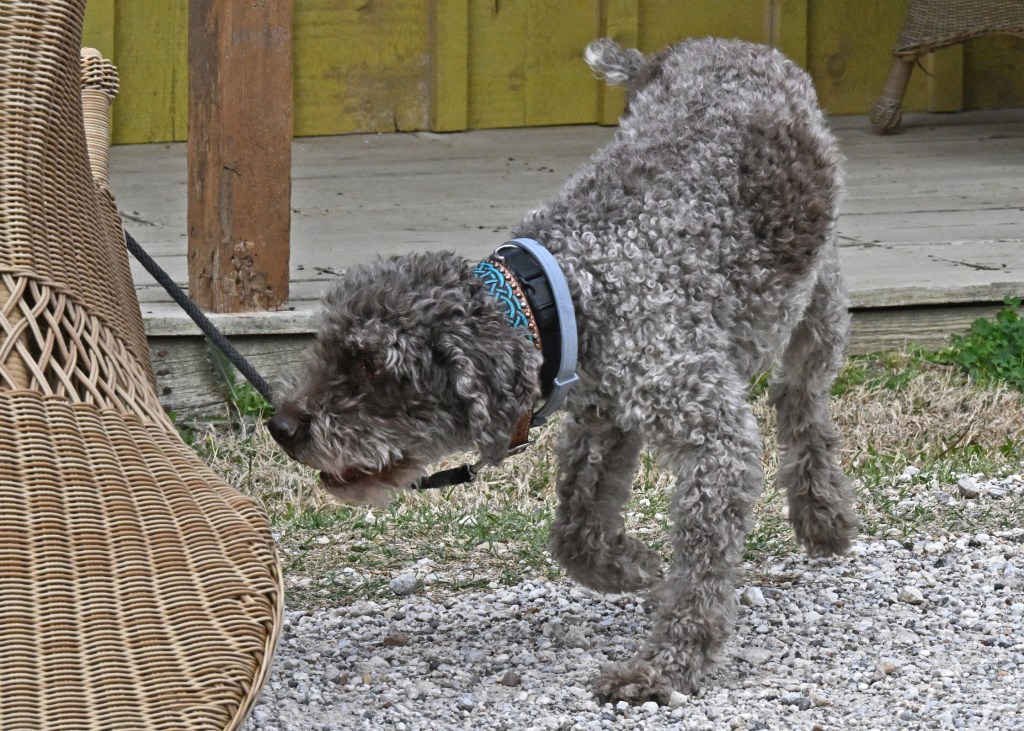
The “selling the hide” error often happens when the handler has not learned to recognize what I call the dog’s “sniff and dismiss” behavior. This is where the dog is taking some sniffs, or “sampling” the air in an area to see if they get any odor. They don’t recognize any odor in that area, so they will move on and sample a different area.
Recognizing what your dog looks like when they are doing the sniff and dismiss is a crucial skill to accepting a “no” answer when you ask them to search an area. And we have to be ready to accept the “no, not here” at any time if we are to truly trust our team member.
Many people do not fully learn this lesson until they are well into Master Interiors, because that is the class where we are truly tested as a team. It is the only class in AKC where we have the possibility of a blank search area, it is the only class where we are forced to make three perfect judgement calls in a row.
I could go on about this, but honestly that is probably enough for today. I have finally learned from my students that a shorter lecture is more productive than a longer one. Have no doubt that I will return to this topic in the near future.
I have finally set my retirement date for my day job, and this means MORE time for scent work and MORE blog posts!!
Have you signed up to get posts delivered directly to email? I am no longer putting all my posts on Facebook. Scroll up to the top (or down to the bottom if you are on a mobile device) and put your email in the black box.


Leave a Reply