It has been a while since I posted, due in part, to the launch of my first online class (have you checked it out yet? You can see it here: https://sniffingaroundscentwork.thinkific.com/bundles/seeing-through-your-dog-s-nose. ) I have gotten some nice comments on it! Someone came up to me at the trial I judged last weekend and told me that she had been able to go up to the start line in containers with more confidence because she had just finished the chapter on containers in the course. I am thrilled that it is helping people.
Anyway, I am getting back on the proverbial blog horse, and have resolved to post more regularly in the coming months.
This week’s topic: “constant correction leads to diminished motivation and a bad attitude” This subject has been on my mind recently.
Years ago, I had a manager whose favorite activity was criticizing. He was a good manager in many respects: he defended his people, kept the workload of the team manageable, and worked hard in addition to his management chores. He never complained about any of us taking time off or having a life beyond work. And he was generally generous when it was time for salary increases.
But people skills were not his strength. His instructions were vague and difficult to interpret, and inconsistent—they tended to change from day to day. If you asked questions, he got angry, so I didn’t ask a lot of questions. On many projects you were left guessing about what you were supposed to do, which led to inaccurate work products.
He also loved to criticize. No report was ever good enough, there was always something wrong, or something you could have done better. Even when the results were good, if you hadn’t done something exactly the way he would have done it, it was wrong.
And nobody’s ideas were good either. If you offered an opinion in a meeting, she would talk over you. Or worse, repeat what you said just as if it were his idea.
It was a good job, but as time went on, I found that my attitude suffered. My work got sloppy. I cut corners, I didn’t always double check for accuracy or consistency. What was the point of doing a good job if it was just going to be corrected anyway? My motivation went way down, as I didn’t feel appreciated. I didn’t volunteer to do anything extra, I did the least amount of work possible. And I did it as slowly as possible. My default answer to anything became no instead of yes. It was depressing. I enjoy doing a good job and like to take pride in my work, and this became impossible.
I eventually left that company and found a better job.
I am thinking about this experience in terms of scent work training.
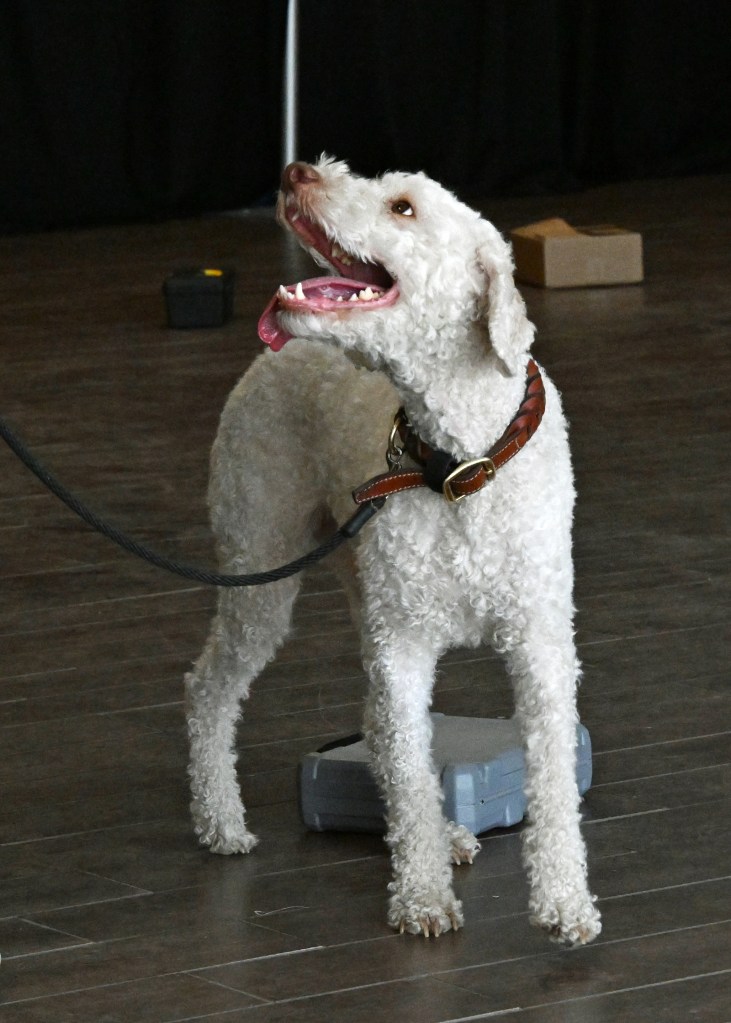
On occasion, I’ve had problems with Yeti shutting down during competition—finding one or two hides and just quitting there, even though we haven’t covered the whole area. Since he is not an environmentally sensitive dog, the problem is, well, probably me. Am I being a de-motivating manager? I decided to give myself a performance review. I have come up with some positive and negative evaluation points to grade myself on.
I’ve made a list of things, little things, that might annoy a scent work dog. Mind you, not every dog. Many dogs are very easy going when it comes to the search, and will happily overlook some handler errors. Yeti is not one of them. He was selectively bred for scenting, scent is his domain, and he will not tolerate any interference in this area. So I need to grade myself pretty strictly.
Positive
Do I let my dog lead the search?
Yes, I do.
Do I reward big in practice? Including praise?
Yes, I do. I almost never fall into the one cookie per hide trap (except at competitions), and I almost always include a lot of enthusiastic exclamations like “what a clever dog!”
Do I reward after the search?
Absolutely. Yeti’s ultimate reward is getting the ball tossed to him, and we do this after every successful search is finished.
Do I help with the search area management when my dog needs help?
Yes. Unlike Astra, Yeti will rarely cover the entire area without enlisting my help, and so I often will give him verbal encouragement and also step in and guide him to areas he has missed.
Negative
Do I nag the dog about leaving the search area?
I admit that I give in to this impulse sometimes. Yeti likes to search really wide, often going twenty feet beyond the search area boundary, and sometimes, under the duress of a timed search, I give in to an impulse to call him back. Does he need this reminder? Probably not. He knows his job, and it is likely that he will turn around on his own when he realizes that he has left the scent cone. Does he resent my doing this? Quite possibly, just like I resented the boss who would nit-pick my reports.
Now, some dogs do need a reminder that they shouldn’t be indulging in an adventure tour. I always tell my students to give the dog leeway, but also a gentle “back this way” will work.
Do I pester the dog about returning to a found hide?
Some of us nag when the dog goes back to a found hide. The first time the dog finds the hide, they get a cookie, but then the second and third time the dogs goes back to it, the handler gets a bit impatient—yes, you already FOUND that one….yes I KNOW, you got that one already….YES, YOU GOT THAT ONE. It is a timed search, and we are all aware of those seconds ticking away.
I admit that I have sometimes done this. Although, Yeti seems to be returning to found hides less often these days. I think he has actually figured out that I don’t want him to do this, and has started remembering where he has alerted. I will mark this one “needs a little improvement.”
(Note: many people are very upbeat when their dog goes back to a found hide –WOW, that’s GREAT HIDE, let’s find ANOTHER ONE– and I think that is a good way to approach it, and doesn’t count for this list of problems)
Also, there are many good reasons for going back to a hide: maybe the dog lost track and doesn’t remember alerting on that hide (I find it interesting that most people admit they have trouble keeping track of hides during a search, but they really expect that the dog remembers exactly where they have searched), or maybe the dog is trying to disentangle two converging hides and is checking out the source of one of the odor plumes and needs to confirm it.
Do I second guess the dog about the hide?
Some people get upset when the dog does not pinpoint the hide. They want the dog to alert exactly on top of the hide vessel, and they are constantly nagging: show me where! Where is it! Are you sure? Are you sure?? This also happens when the handler just doesn’t trust the alert behavior—often after the dog has gone through a learning phase of false alerting—and so feels like they have to always question the veracity of the alert.
I have to admit to being guilty on this one too. In my defense, Yeti fringe-alerts quite a bit, and sometimes when I ask for clarification, he does get closer to source….but in truth…I really need to be careful about how much I do this.
Do I get upset when the dog misses one or more hides?
Some people get upset in competition when the dog misses a hide. Missing one or two hides is a very natural mistake when the areas are complex and the hides are converging. No being, dog or person, is perfect, and yet many people assume that just because it is in the competition rules, our dogs should find EVERYTHING every single time we search. How many tasks do you perform perfectly every single time?
I will admit that I have, in the past, been upset with Yeti about missing hides. However, this year, I changed my attitude and have been able to keep a good sense of perspective about missing things. I will mark myself “improved” on this issue.
Overall, I think I get a 7 on the performance rating scale (where 1 is bad and 10 is perfect). Definite room for improvement, and I am going to keep these things in mind for our next trial.
Have you signed up to get posts delivered directly to email? I am no longer putting all my posts on Facebook. Scroll up to the top (or down to the bottom if you are on a mobile device) and put your email in the black box.

 Sniffing Around Scent Work
Leave a comment