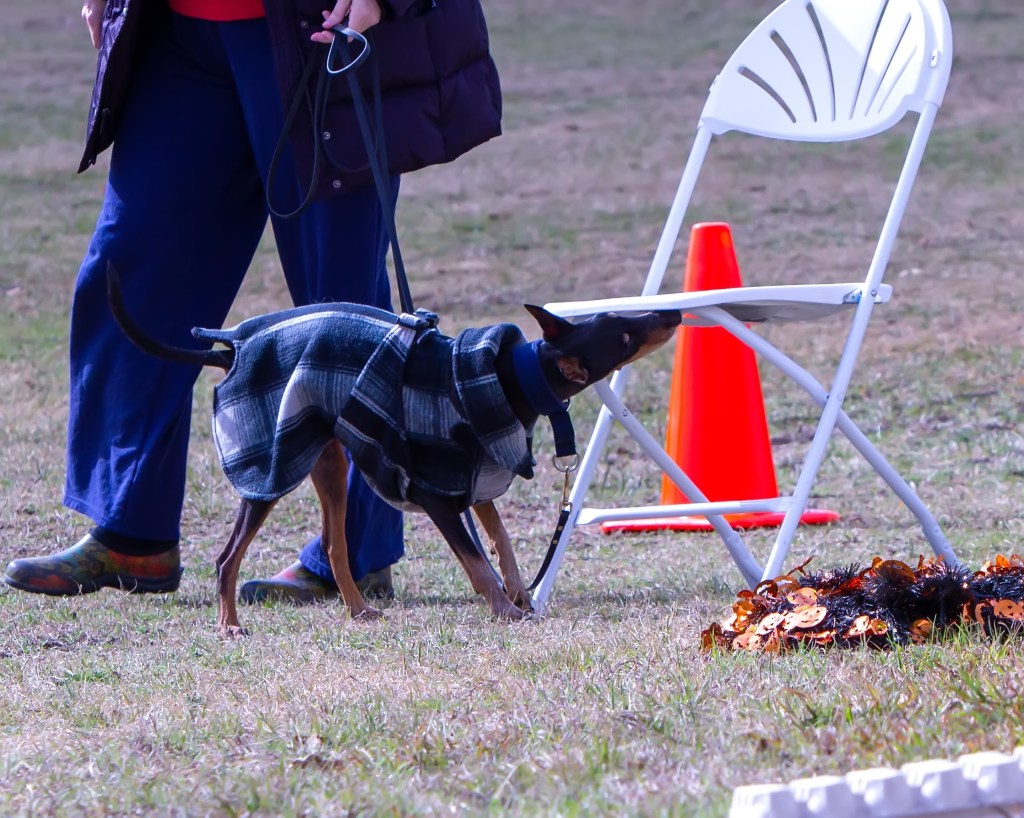
Jimmy Choo was the first dog I saw do this. We were in class, and Jimmy was working in a room with two hides. He had found the first one readily, but couldn’t seem to hone in on the second one. After a few minutes of frustrated trotting around, his handler, Dina, turned to me, “I think we need some help. Where is it?”
“Over on the table” I responded. Before she could do anything, Jimmy trotted over to the table, pinpointed the hide in the corner, and gave his alert. Dina and I burst out laughing.” I guess he was listening to you,” she said.
We thought it was a joke at the time, but after this, I started to notice more and more dogs would seem to understand when I gave their handlers verbal directions as to where the hides were located. They understood “wall” and “table” and “chair” and even things like “down low” or “on the floor.” At first I thought that the dogs were seeing me look in the direction of the hide and taking their cue from that. But I noticed that even when I made an effort to not look in the direction of the hide, but just gave directions verbally, the dogs still seemed to understand.
It sounds a little crazy. We all tend to anthropomorphize our dogs—is this just part of that? But I talked to other instructors who saw it too. And last week I came across this article: Some Super Smart Dogs Can Pick Up New Word by Eavesdropping. It talks about a study done with a small number of dogs who were able to learn the names of new toys just by hearing two people talk about them. So scientists are seeing it too.
And if the dogs know the names of objects, what else do they know?
They know who puts the hide out. Want to know why your dog does SO WELL at home, but seems clueless in class? They may be reading you. They know you know where the hide is, and many times it’s easier to read your behavior than it is to actually do the sniffing.
And even in class, they may be reading people. Some of the dogs in my classes know that their handler doesn’t know where the hide is, but I know where the hide is. After all, they see their handler looking to me for a “yes” after they give the alert. These dogs will often give their alert to me instead of the handler. It makes sense…why not save time and just cut out the middle man?
Our dogs are relentless in their pursuit of cookies, it seems. Which brings me to the topic of the double blind search.
The scenario I just described above is known as a single blind search, and is how most scent work classes are organized.
A double blind search is where no one in the search area knows where the hide is—not the handler, or anyone else. The dog can’t get information from any person to help him search. So how do we know if the dog is correct when he gives an alert? The handler has to physically look for the hide. If the handler can find the hide, the dog gets their reward. If the handler can’t find the hide, then they can ask the dog for clarification, and continue to look, or they can give up and leave the search area.
I like to incorporate double blind searches into my classes from time to time. The double blinds short-circuit that tendency for the dog to look to humans for information, and I feel that they are a more natural way to practice searching. Our single-blind searches have evolved from the logistics of classes and competitions—they are more time efficient, and allow us to run multiple dogs on one search scenario quickly.
But double-blind searches more closely mimic the real world environments, where you are actually relying on the dog to locate something—whether it be birds, or mushrooms, or illegal drugs. I think our dogs enjoy these more. Instead of playing a game just to please us, and get a nice treat, they get to contribute, to be a true partner. They knew something we didn’t know! They FOUND it! Ha ha! Take that, smarty pants humans!
So, if you have an experienced dog that you think might be taking their cues from you, you might want to consider throwing some double blind searches into the mix. Have your instructor, or a friend, put out a hide (or two) and then leave the room. If your dog searches but doesn’t find it, well, you can ask for help. If your dog does find it, you can celebrate the find and have a party.
Please note that I said experienced dogs. I don’t generally find it advisable to use double blinds for beginner dogs or unconfident dogs who need to get their rewards quickly. And if you are not sure if your dog is experienced enough, find a good trainer and ask their advice.
Have you signed up to get posts delivered directly to email? I am no longer putting all my posts on Facebook. Scroll up to the top (or down to the bottom if you are on a mobile device) and put your email in the black box.


 Sniffing Around Scent Work
Leave a reply to trioofdogs Cancel reply