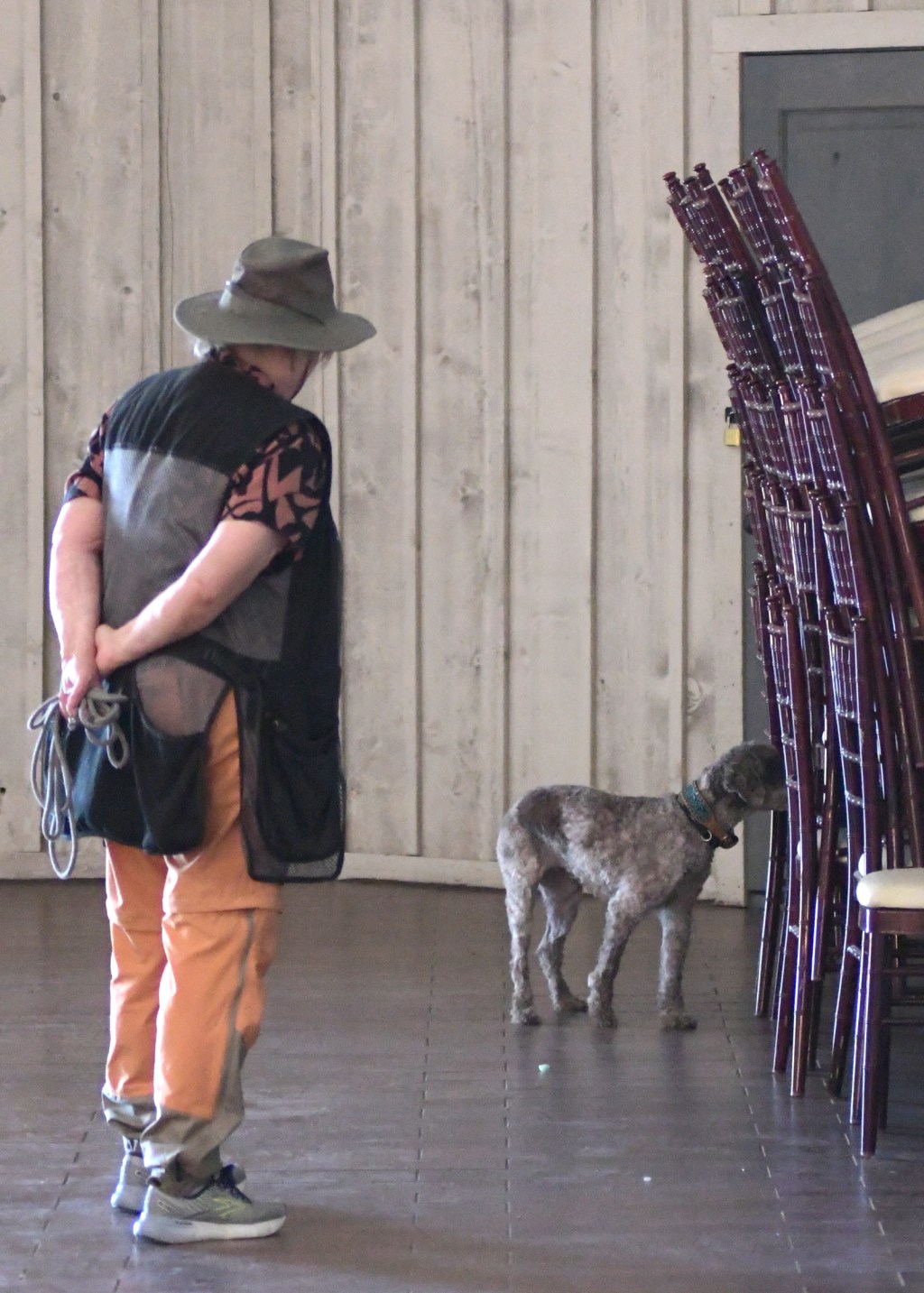
I follow a few good trainers/teachers, because the learning in this sport never stops, and I need good information. One of these trainers is Cameron Ford (K9s Talking Scents Discussion on Facebook), who has been around forever. I caught a quick video clip of a conversation Cameron was having with another trainer, and he was talking about the fact that in the old days, the professional detection dog handlers ran strictly directed searches, with the dog on a short leash, and the handler “presenting” every 12 inches. In those days, he says, the handler influence was everything, and now, the handler is supposed to stand back and do nothing, and just watch the dog. Everything in life swings on a pendulum, from one extreme to another, and handling in scent work is no different.
I have been thinking about this pendulum for quite a long time now, but I had thought that it was restricted to the sport detection world. I should have known better, it’s a universal.
Back when nose work had just started in Texas, you saw a lot of this sort of old style “cop handling” in the UKC search areas. (For those of you who are not familiar with this, it is where the handler controls the search, using the dog like a Geiger counter, expecting her to give a trained response when the handler leads her to a place where there is target odor.)
I admit that I experimented with this style also, mostly in the upper-level containers searches with Riley the Chihuahua. I even taught it to some students. I soon figured out that many times the directed searches did not lead to good results—it caused a lot of false alerts, and didn’t seem to make much sense to the dog. I stopped doing it.
After I became a judge, I saw this often. Handlers would back around a car, carefully pointing or gesturing, and the dog would dutifully follow, usually right over the hide without a flicker of recognition. And then when the handler would briefly pause, the dog would give the trained alert, and the handler would call “alert” and get a “no” in response, and everyone would leave the field frustrated and puzzled.
Much of this was due to bad training. If a dog is forced to focus on the handler, then it is not free to follow the odor stream to source, and is more likely to give an alert based on the handler’s behavior, or to fringe on the first bit of odor that he encounters.
There is a huge culture clash here: humans think visually, in straight lines, and odor follows the laws of fluid dynamics. It does not flow in straight lines or follow the logic that we think it should. Dogs need to follow a lot of convoluted, twisty pathways to source properly.
Even if the dog has been trained properly to understand that odor is the priority, and not to alert in response to handler behavior, a directed search will still cause a dog to miss a hide. I have seen this many times in competitions.
I remember a particular Detective search that I was judging. The handler, determined not to miss a hide, was detailing her German Shepherd very slowly and carefully around a hallway. Her hand was outstretched and the dog’s nose was dutifully following it.
I had put a hide underneath a water fountain, an easy, accessible hide that most teams were finding right away and I watched as the team went right over the fountain, the dog’s nose maybe eight inches away from it, without the dog giving a flicker of recognition, or an alert. Nothing. They continued down the hall, and the dog eventually alerted on a low hide by a door, and several others (so I could see that the dog knew how to alert on target odor) but they never returned to that area because the handler assumed that it had been covered. I have no doubt that the dog couldn’t get the odor in the way that the handler was forcing the dog to search. The angle was wrong, or the dog needed more information.
We humans just do not understand the information gathering process that dogs use to find and source hides—I cannot say this enough—it is NOT straightforward, as vision is. It is more like finding clues here and there and then deducing the location of the source.
Fortunately, as the sport grew, we all learned more, and some of us were able to find NACSW or other knowledgeable trainers who taught the “hands off” search style. This is where the dog is the leader of the search, on or off leash, and the handler mostly follows. Sue Sternberg has done a good job of writing about the freestyle search in her book “The Dog Driven Search.” (While I don’t agree with everything in this book—it was written for NACSW competitions—there is still a lot of good stuff there.)
The dog driven search is much more fun for everyone concerned, and produces faster searches (and therefore more placements) in small areas, which is the vast majority of the areas in the lower-level competitions. It also encourages handlers to watch and understand what their dog is doing instead of forcing the dog to conform to our human-centric sensibilities and choices. This is important if you really want to consider your dog a partner, not just an employee. Our dogs are empowered to make so few choices –we control every aspect of their life—that I think allowing them this freedom is crucial.
The problem with these searches is that they are not perfect either. Dogs do not understand the concept of search boundaries (unless these are solid walls) and also, the nature of odor is capricious and does not always lend itself to a search in which ALL of the hides are found. (And honestly, how much in this life IS 100% effective? Well, that is a topic for another day). Dogs on their own are likely to overlook or miss hides, especially in a multiple-hide situation where there are overlapping scent clouds that need to be untangled. I think that we as humans truly underestimate the difficulty of multiple hide searches. Have you ever tried to untangle two skeins of yarn snarled together while someone watches with a stopwatch? Ok, also a topic for another day.
So, there we have the pendulum: handler controlled searches on one extreme and dog controlled searches on the other—both are imperfect.
In theory, the middle ground, that is, a search where the dog sometimes leads and the handler also is empowered to make suggestions, is the style which is going to yield the best results.
This is especially true in the highest levels of competition, namely the Detective Search in AKC, and the Elite and Summit level searches in NACSW, and the equivalents in the other organizations. At these levels, the search areas are very large and complex, and with a large number of hides, it is very easy to miss one or more, even with a very skilled dog.
But what does the middle style look like, and how do we achieve it? That is the holy grail of this sport, and absolutely a topic for more posts. Stay Tuned.
And if you haven’t already subscribed, now is the good time to find the black subscription box (on the right) and put in your email.


 Sniffing Around Scent Work
Leave a reply to ellenheavner Cancel reply