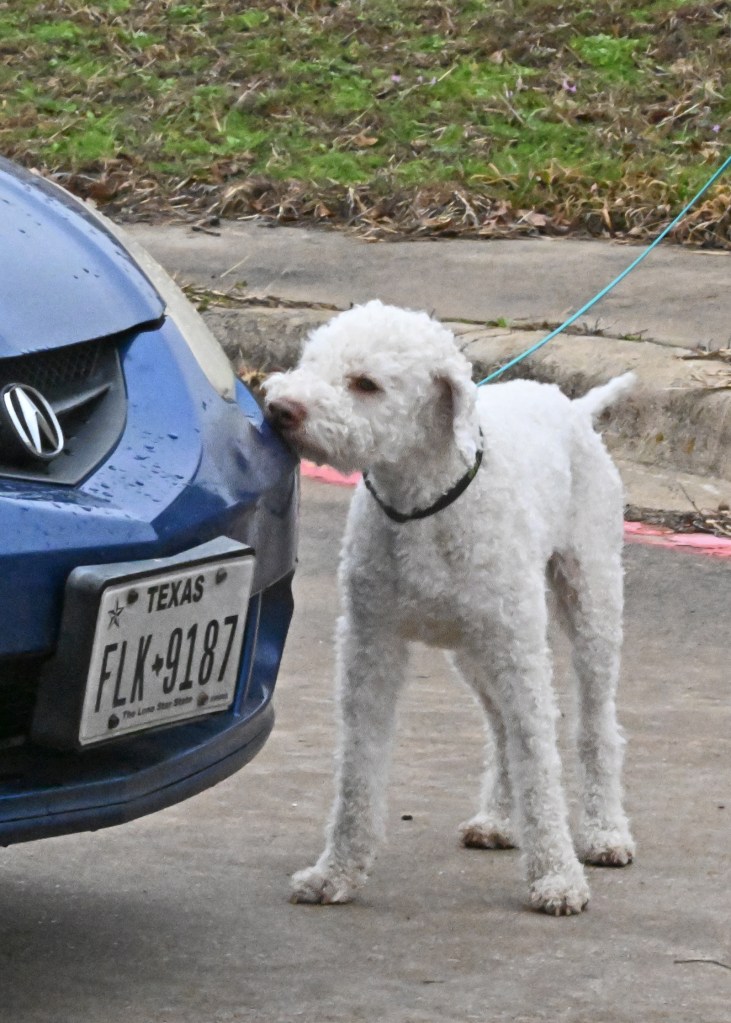
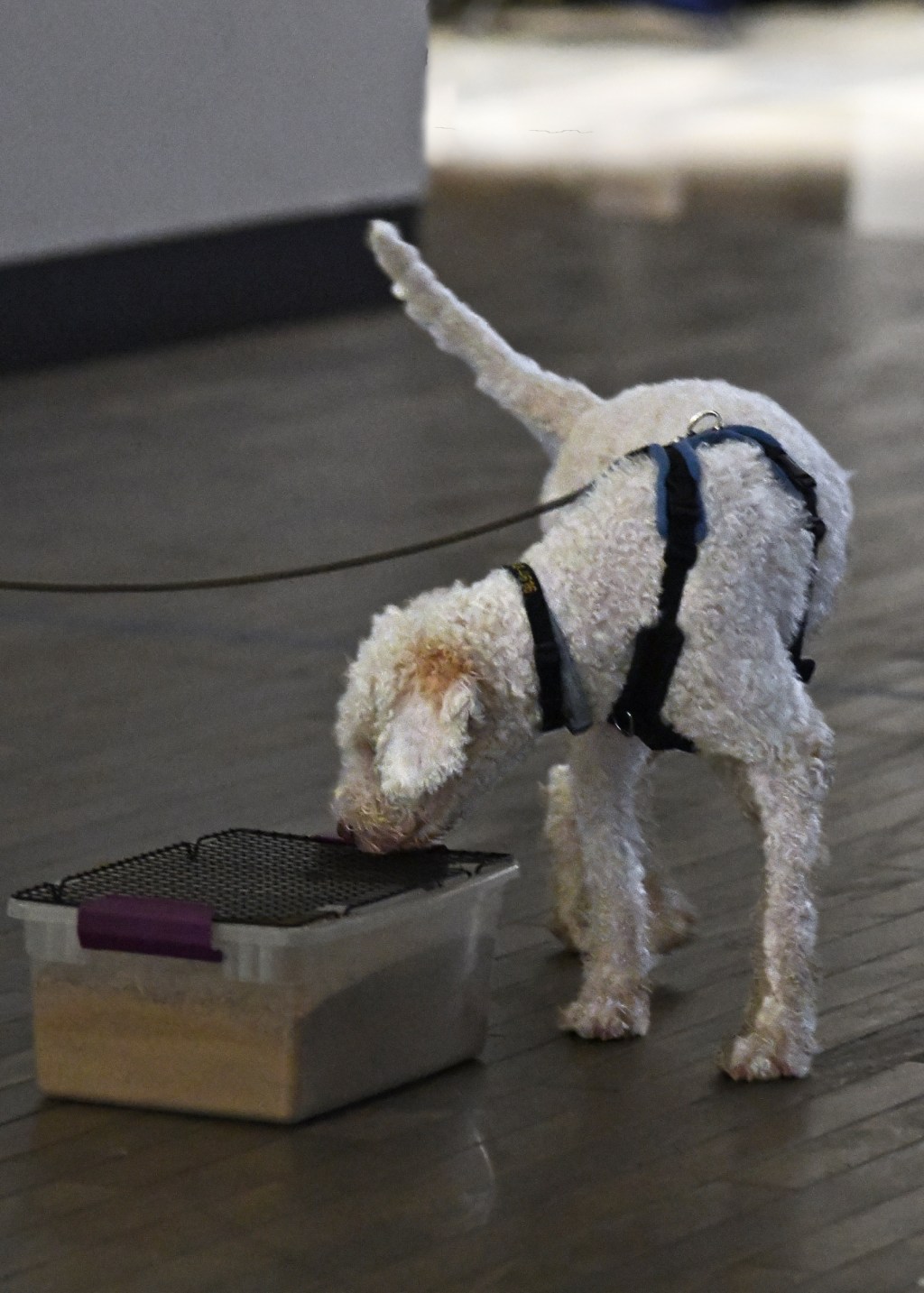
I trialed Yeti last weekend, in UKC vehicles. I wanted to test out where he was in his training, and while the results were disappointing (no Qs for us!) I felt that he worked well, and that there was progression.
We were trialing at the Masters level, which means searching five vehicles, with three hides and a hidden distraction (toy or food). Say what you will about the UKC venue, if you want a good vehicle challenge, trial UKC at the upper levels. The presence of a hidden distraction, and the number of vehicles you have to search require some skills-polishing on the part of both dog and handler.
On our first run, Yeti found hide one fairly quickly, after doing a quick inventory of the vehicles. Then, he honed in and alerted on a trailer hitch. It was a solid alert, and I called it without hesitation. And got the dreaded “no.”
However, the judge was kind enough to let me know that the dog who had run just a minute before me had falsed on that hitch. I immediately felt better. At least Yeti had not been randomly picking items to alert on; it was a mistake any dog could have made, and part of a false alert cascade.
Some of you may not know what this is. It goes by many names, the Search and Rescue folks tend to call it the “adrenaline dump.” Anyone who judges or watches a lot of dogs searching has seen it: once a dog falses on a spot, other dogs are very likely to false alert there. And it becomes a self-fulfilling prophecy: the more dogs that alert there, the more dogs will alert there.
When I am judging, I always dread this happening. It means that my q rate is going to drop radically. And it is not exactly the dog’s fault.
BUT WHY I can hear you asking. We have trained our dogs to react to the presence of target odor, not other dogs!
We don’t know exactly why this happens. The predominant theory is that dogs dump some sort of adrenaline or dopamine related odor into the air, in anticipation of a reward. Other dogs recognize this and react to it by also alerting.
I suspect that this is more or less analogous to what happens to humans in a traffic jam: you are sitting on a main road in traffic that slowed to a crawl, and suddenly you see the car in front of you put on their turn signal and turn off onto a side road. You turn your car and follow them, because you assume that they know about an alternate route that will get you out of the traffic. You don’t know for sure what this driver is doing, but it seems like a reasonable assumption.
Dogs, like people, are highly social beings. I suspect they react to the “alert here” scent without thinking about it, assuming that the other dog knew what they were doing.
But undoubtedly contributing to this is the fact that most of us are training our dogs in a group class, so that almost every time they alert on a hide, another dog has also alerted on that hide and left the “ALERT HERE” scent. This is what they call the concomitant odor problem. If the “ALERT HERE” scent is present with the target odor the majority of the time that the dog encounters it, the dog assumes that it is part of the picture they are supposed to alert on.
When I first learned about this phenomenon, I thought that surely we could train our way past it. I have, over the years, tried various methods to get dogs past this. I have had dogs slobber on boxes, and eat food near an object, on the assumption that whatever the invisible signal is, it has to do with food or the anticipation of food, but that has not worked.
Possibly, if you had access to dogs who were trained on different target odors, (for example drug dogs) you could create some sort of proofing exercises: put some drug odors out, have the drug dogs alert on those, and then run the essential oil trained dogs. If the essential oil trained dogs alerted where the drug dogs alerted and then didn’t get rewarded, perhaps we could extinguish that behavior.
But I suspect even that would fail. There is a strong social component to this behavior, and I suspect that would make it very difficult to train away from. And even if you never train in a class, when you go to trials, unless you are first in every class you run, your dog is encountering the “adrenaline dump” in the classes he runs. And every time he is rewarded for both target odor and whatever it is that the other dogs leave behind.
In fact, Yeti very rarely runs in group classes, and I was hoping that we would be able to minimize the false alert cascading. But this past weekend proved me wrong. At least I know enough now not to blame him: he was just doing his job and being a dog. Better luck next time.
Want to get these posts delivered to your email? Click on the Home button on the left, scroll down to the bottom and put your email in the SUBSCRIBE box.


 Sniffing Around Scent Work
Leave a reply to Donna Cancel reply