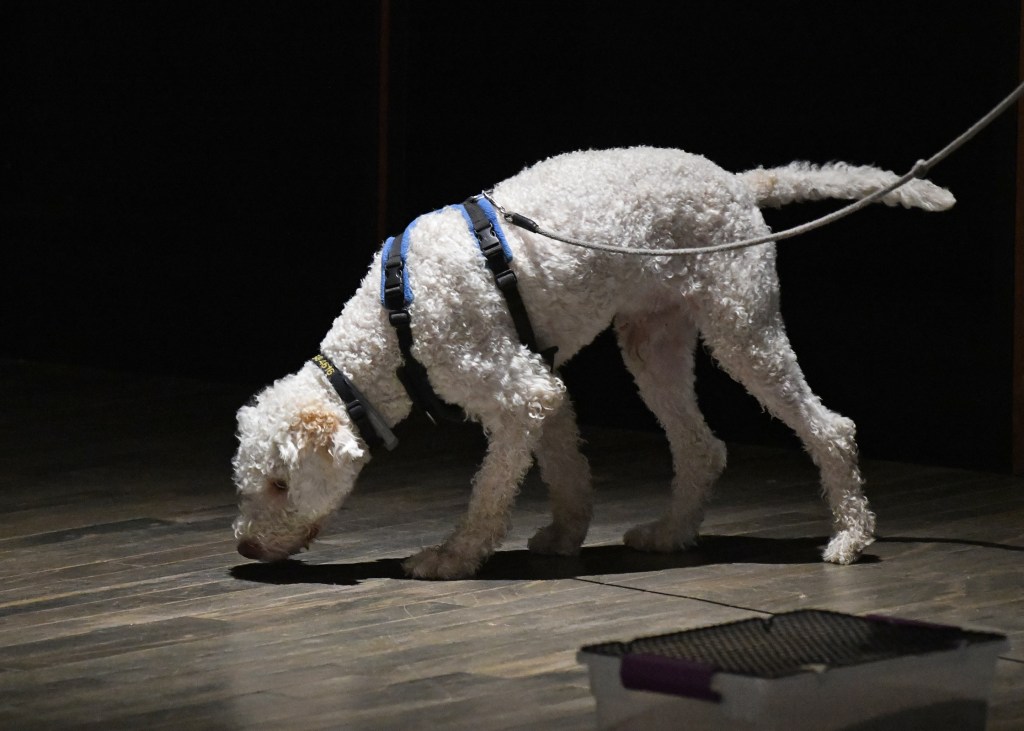
A few weeks ago I was judging the upper-level buried element classes at a trial. Everything was in order, the hides were set well ahead of time so that they could age appropriately. We were indoors, in a school. Buried was set up in the central area of the small library.
The Excellent level requires three hot containers and I had set up two hot sand bins and one hot water bin. They were set up in two rows, which can be a difficult configuration because of the high level of odor convergence, but the hot bins were all placed well away from each other, and since we were not outside, we didn’t have to worry about the wind blowing the odor around. Yay!
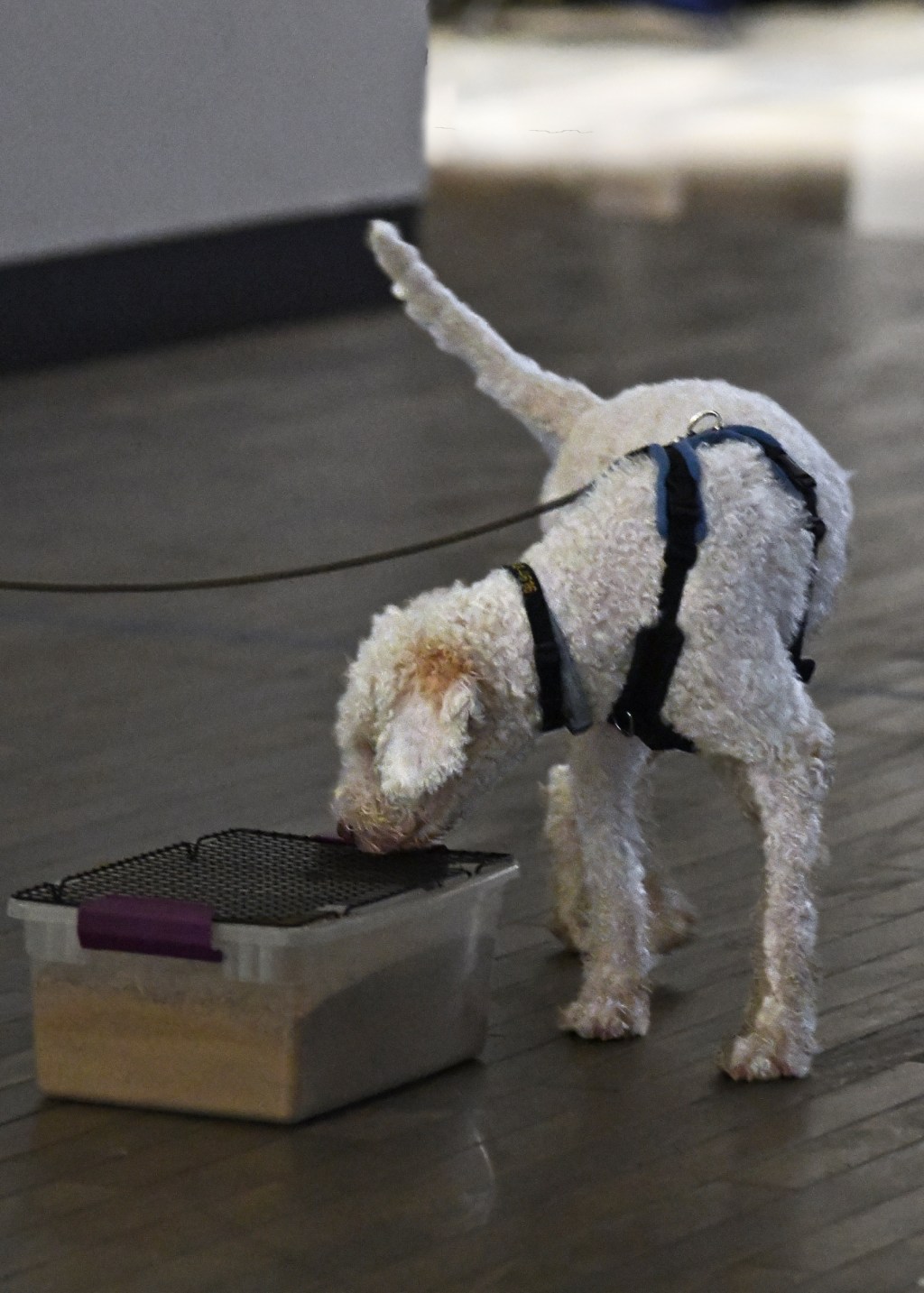
I ran Astra as my demo dog, and she worked the odor along the side of one wall, along the long row of bookcases there before indicating correctly on the two sand bins in the left hand row, and then showed me that the odor from the water bin on the right hand row had spread into the adjacent area where some large tables had been set up—she circled around those tables, working the edge of the odor cone, before giving her indication on the hot box.
My Lagottos like to work the very extreme edges of the odor cone, which means that they gather a lot of information far away from the hide, but I know many dogs will get information closer in, or they will learn to work the odor close to the bins, so I was not worried about the hides. They were findable.
So I was optimistic about getting a good pass rate. And I was about to be disappointed.
I watched helpless as team after team came to the start line and worked up and down those rows, and left after getting maybe one hide and a no, or an immediate no. The handlers were all working their dogs on short leashes, many of them holding the lead straight up, as if handling in a confirmation ring, and encouraging the dogs to sniff right over the center of the bins.
Just about all of the dogs tried to veer over to the bookshelves on the left side (see diagram below), since that is where the odor had drifted, and they needed to gather the information from the edge of the cone about the exact location of the hide. And ALL of the handlers pulled their dogs away from the bookshelves, chanting, no, don’t search the shelves, search over here! We are doing buried, not interiors! Search! Search!
Dutifully, the dogs would come back and sniff the bins, and, not being able to figure out exactly which bin was hot, would eventually alert on a cold bin, often the bin next to the hot one.

If the handlers had just trusted their dogs enough to let them search off leash, or at the VERY LEAST, given them enough leash to let them search over on the bookshelves, I feel sure that at least some of them would have been able to work through the scent odor puzzle to work out where the source was, and alert on the correct bin.
It really makes me sad that handlers can’t trust their dogs and give them more leeway in the search. If only people would let the dogs go where they need to go to gather information!
However, because we don’t have the nose or brain structures to perceive or follow odor in the same way that dogs do, we assume that odor MUST work in the same linear way that vision does. We KNOW that the odor is contained in the bins, therefore you must have to be directly over the bin to get the odor. So just about everyone forces the dogs to work the bins.
BUT odor does not work in this way. It is not linear, and often the dogs get valuable information about where the source of the odor is, FAR away from the actual source. This is the biggest obstacle in scent work: getting people to understand that 1. We don’t understand odor and 2. The dog DOES and 3. The fastest way to a Q is NOT always a straight line.
(NOTE: This is part one of what will be a series of posts on the enigmatic Buried Element. )
Want to get these posts delivered to your email? Click on the Home button on the left, scroll down to the bottom and put your email in the SUBSCRIBE box.


 Sniffing Around Scent Work
Leave a reply to plcpeggy Cancel reply