In one of my earlier posts (Calling Finish on Unknown Hides: Strategies and Philosophies) I discussed the two philosophies in when to call finish on unknown hides situation: you can let the dog run the search, and learn how to read the signals of when he is finished searching and has found all the hides, or you can train the dog to keep searching until you decide that he has searched everywhere. There are pros and cons to each approach, and I have experienced both of these. But I had not really decided how I wanted to approach unknown hides with Yeti.
This past weekend I had a chance to just see what would happen, as I had the opportunity to run two upper level interiors searches, where the number of hides were unknown.
This was a bit premature, as I had not trained for this level and had only practiced unknown hides with Yeti once (and that practice didn’t go well). I train mostly train on my own, so it is difficult for us to find opportunities to rehearse this scenario.
The rooms we were searching were good sized classrooms in an elementary school, and they were moderately cluttered. Not the easiest situation, but not the hardest either. I would have preferred a nice clean conference room, with just some chairs and some tables, but whatever. We took a deep breath and dove in when our turn came.
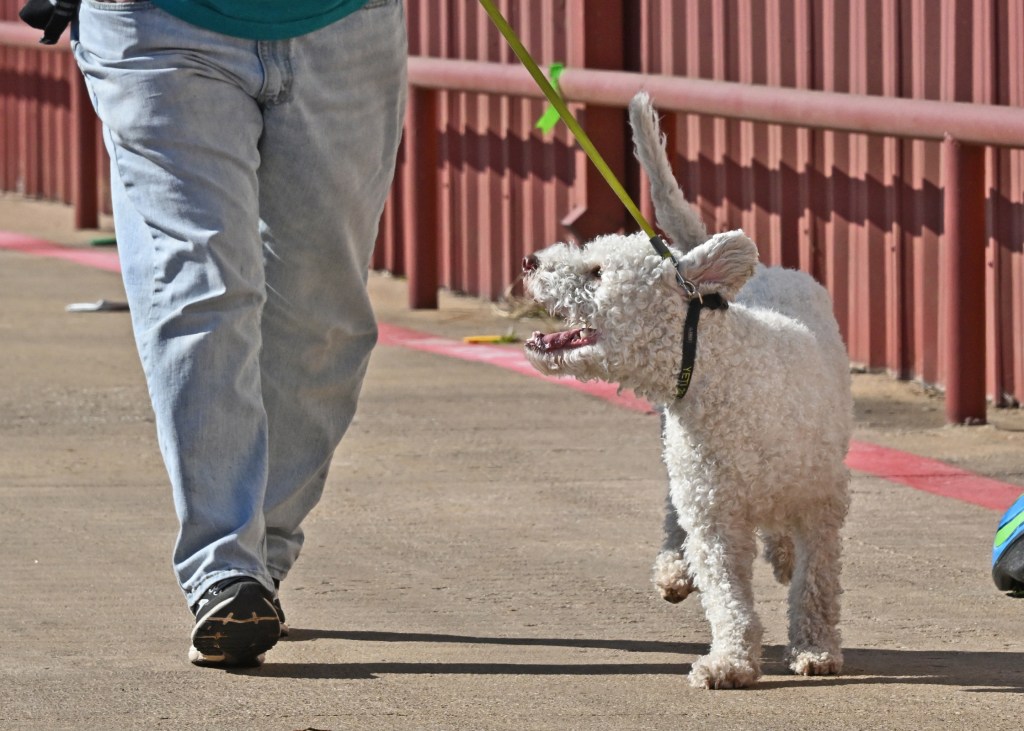
Yeti astonished me in the first room by giving me three very clear “all done” signals. There was one hide, which he found after doing a circuit of the room. He continued to search a little after that, and then came directly in front of me and gave a little hop to get my attention (you can see this in the video below at about 1:04).
Being a stupid human, I ignored his signal and moved him into an alcove which I didn’t think he had gotten deep enough into, and he very graciously obliges me by searching it, and then continuing to search a couple of other areas before returning to me and gently GRABS my jacket and tugs on it (you can’t see this clearly in the video because my back is to the camera, but it is at the 1:25 mark) Signal 2, more emphatic this time. He has NEVER done this during a search. And I remember thinking IS HE TELLING ME HE IS DONE??
But I just couldn’t process it (stupid human), so I kept walking, over to a corner (which he has already searched), and now he jumps on me again (SIGNAL 3), and AGAIN I ignore him. And now he walks over to a bookcase, sniffs it cursorily and gives his alert sit (you can’t see this in the video because of the camera angle, it is at 1:53). This was the inevitable “false alert” which is what most dogs will do if you ignore all of communication that they have found all the hides and finished searching. And many dogs have a predictable limit of how many times they will tell you they are done. Apparently three times is Yeti’s limit.
I call alert and get the “no” from the judge, so now it is clear that he HAS been telling me, and I call finish.
Here is the video of room one:
Interiors 1
After finishing in room one, we went immediately into the room two, and he searches very nicely, finding two hides, and then re-covering part of the room before coming and jumping on me. Amazingly, I actually see his signal this time, and I call finish correctly.
Here is the video of room two:
Interiors 2
This performance still amazes me. HOW did he know that I didn’t know how many hides were out there, and that he needed to tell me he was done?
Although I had not practiced unknown hides at home, I had been able to practice the “find again” command after finding all of the hides at home (which is the precursor to training a true unknown situation). And in those practices, I had mostly called finish while Yeti was still busy searching.
So I honestly didn’t expect him to give me any kind of signal. I expected him to keep searching, and that I would probably wait until the 30 second warning to call finish.
Was it that he understood the trial was testing us? I do know that he understands that trials are different: I am nervous, there is a lot of waiting around with people who are different from everyday training class, there are strange people watching us during a search, AND there is someone different in charge (giving out the YES word).
Was it just my body language? More than likely. Domestic animals are quite adept at reading us. I tell the story of Clever Hans in all my beginning nosework classes (if you don’t know it, Wikipedia has a great entry on him, here.) But it still flabbergasts me. He KNEW.
But, back to my previous post on the two schools of thought (seriously, go back and read it): this is where the theory breaks down. If I were of the “my dog should search until I tell him to stop” school, then both of these searches were abject failures. I was a failure because I didn’t see my dog had searched the room thoroughly, and my dog was a failure because he didn’t keep searching.
And I would need to go back to training, and figure out how to get him to keep searching, without false alerting when I ignore his signals. There are a few tricks to do this, and I am sure I could come up with some more exercises. But it would likely be a struggle. And why struggle if I don’t have to?
Of the two of us, I am going to trust HIM to know when he has thoroughly searched. He is the one with the nose, and the brain structure to go along with it, and of the two of us, I am sure he is less stressed and therefore thinking more clearly than I am.
Of course, he is not going to ALWAYS be right. There will be times when he misses hides. But I am prepared to live with that. He has been very patient with me, and I am going to strive to emulate that.
Want to get these posts delivered to your email? Click on the Home button on the left, scroll down to the bottom and put your email in the SUBSCRIBE box.





Leave a comment