It’s been almost a year since I posted some fun scent work related reading, and I feel like it might be time to do some more. I have been on a Search and Rescue reading binge…who knew there were so many fictional, biographical or semi-biographical books on Search and Rescue?
I am going to post these in installments, as otherwise it makes for a very long read.
My favorite SAR book has always been Scent of the Missing (reviewed last year) and even after reading five more books set in the SAR world, I have to say that Charleson’s writing is still the best. However, Scent of the Missing was set in the now distant past, and I suspect much of it was written far after the events she talked about actually happened, and perhaps, just perhaps, that distance allowed the storytelling to take on a slightly romantic hue.
I was totally unfamiliar with SAR before I read Scent of the Missing, and even after I read and re-read that book, it wasn’t clear to me how it worked….Charleson is very good at lyrical prose, but her explanations of how the search teams worked were lacking detail. If you too, are unfamiliar with SAR, here is my layman’s explanation: SAR teams come in two flavors: volunteer and professional (usually federal or local police teams). The volunteer teams are dedicated groups of individuals who spend a great deal of their own time and money training search dogs, and learning skills like compass reading, lost person behavior, and first aid, so that they can help law enforcement find missing people. Not all team members run dogs, many folks are “flankers” or search coordinators who help plan and run the searches.
There are three types of SAR dogs: live find, or “air scent” dogs, who are trained to find any living person in a large area search, HD or “cadaver” dogs, who are trained to find human remains, and trailing dogs, or “scent specific” dogs, who find only a specific person, based on a scent article they are given at the beginning of the search. Some dogs are cross-trained to do several of these things. The SAR dogs obviously are different from our competition dogs in many ways: they work really huge areas, and for long periods of time, they are literally dealing with life and death, and their handlers train very seriously. But they also have many things in common with our competition dogs, including issues with false alerts, handlers working to read their dogs correctly, training techniques, and the joy that comes with true partnership.
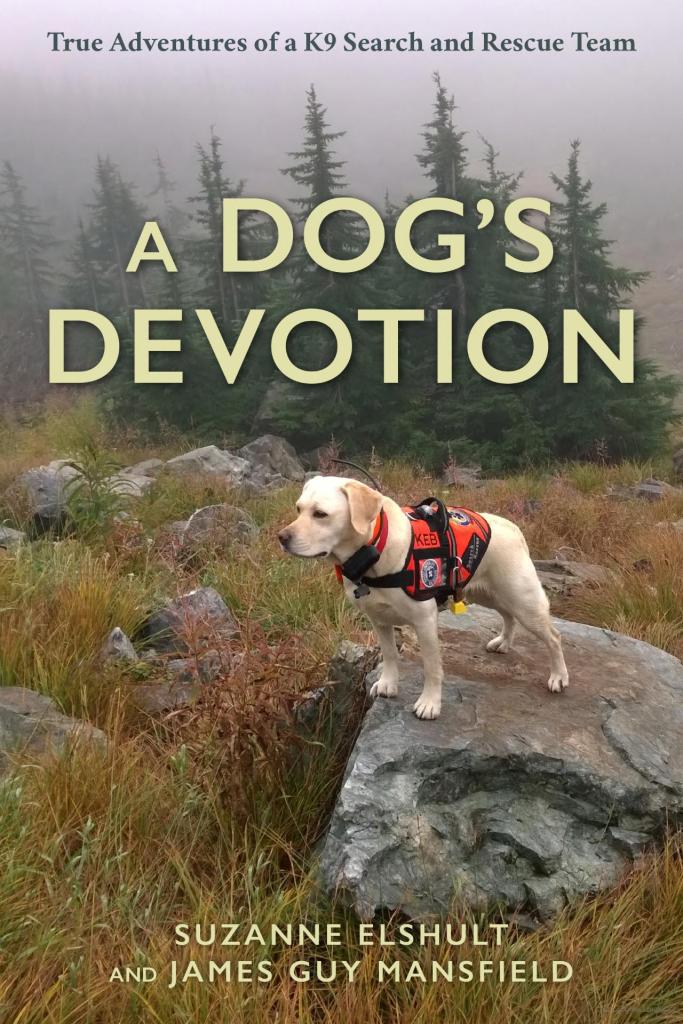
The latest SAR book that I have read may have taken my top favorite spot. It is called A Dog’s Devotion: true Adventures of a K9 Search and Rescue Team by Suzanne Elshult and James Guy Mansfield. Suzanne is a Swedish handler, whose lab, Keb, is trained in both live find and HD work. Now, I have to say, the writing in this book is not as smooth as Charleson’s writing, and I dislike the technique of having the narration alternate between her and Guy, who is her support and search partner in most searches, BUT that did not stop me from being totally engrossed in the stories she was telling.
Suzanne was inspired by the 9-11 crisis to train a dog and join a SAR team in Washington state, and she tells the stories of seven of the search events she participated in. I love the descriptive detail of the deployments, the planning, the decisions involved, the exhaustion and elation of wilderness searches. I was sucked into many of the chapters as if they were murder mystery stories….would they find the person? Would they be alive or dead? Did they ever get the full story on what happened?
Suzanne is also brutally honest about the complex politics that plague most teams. In her words:
“Political resistance is a phrase encompassing two concepts that are unfortunately common in the K9 world: ‘my dog’s better than your dog,” and ‘my K9 training method is the only training method in the know universe that works.”
She describes briefly more than one team disintegrating under the pressure of egos and disagreements. She also describes the same struggles with false alerting that plagues us as competition handlers, specifically one situation where her dog alerted on a dead fish, and another where the dog gave in to pressure and alerted because Suzanne had her search over the same area too many times.
This book is well worth the read. I initially bought it as a Kindle book, but am going to order the paper edition so I can reread it more readily.
So that’s number one on my list. Number two is coming up shortly.


 Sniffing Around Scent Work
Leave a reply to Sherree Cancel reply