
My collection of distraction cotton balls
So, it has been a very busy month, but finally I have had some time to sit down and work on the post I promised about training the Handler Discrimination (HD) element.
These are not step by step instructions, exactly, more like some tips that I have jotted down that might help you if you are embarking on an HD journey, or, if like me, you got stuck at some point in the process.
Remember: there is NO ONE right way to do anything in dog training, and Handler Discrimination is no exception to that. Part of the magic and wonder of working with dogs is that no matter what training techniques we use, they always learn from us.
I actively encourage folks to experiment and see what works best for them and their dogs.
First and Most Importantly:
Practice, practice, practice, practice!!!! And then practice some more!
If your dog has been on odor for any length of time at all, you probably have hundreds of repetitions on essential oil targets. Those hundreds of repetitions have set up expectations of what he will be looking for, and how he will encounter it. As discussed previously, the HD odor behaves differently. So your dog will need lots and lots of practice to learn how to hunt that odor effectively.
Different Commands, Different Start Line Routine
Initially, when you start to do HD, the dogs will usually automatically search for oils. Using a different command and a slightly different start line routine will help your dog to figure out which odor they are searching for. Most people bring an extra scent item and show it to the dog before they start, or they give the dog the scent from their hand. The AKC rules allow you to re-cue the dog during the search with a scent item if you think the dog needs it, and I have to say that I have found this handy.
Scenting and Storing the items
Scenting the item: I make sure that my items (glove and cotton ball) are them well scented by putting in my shirt or bra and leaving it there for at least several hours. If I have the chance to go out and work up a sweat in the garden while wearing an article, I do that. I feel that the dogs do better if you start them with a really saturated item, then later, you can transition to less scent. Once the item is scented, I store it in a glass jar or a zip lock baggy.
Don’t forget that you have the option of using a sock in AKC, and frankly if I were going to do it all over again, I would probably use one of those. According the “The Joy of Sweat” the foot has the most sweat glands per inch of any part of the body, therefore it will be relatively easy to scent, and it is easier to wear a sock than stuffing a glove in your shirt.
You also have the option of using a Q-tip instead of a cotton ball. There is a theory floating around that a q-tip might be a better “carrier” of scent for HD than the cotton ball, since the q-tip is also used for essential oils—so it is a familiar component of the scent picture. I have done a little experimentation with this, and haven’t seen any evidence that it is easier for the dogs. If anyone out there has done this, I would be interested in hearing about it.
Distraction Items
I feel it is essential to have a collection of at least 3 to 5 distraction items, that is, gloves and cotton balls that have been scented by other people, in order to get your dog to generalize not alerting on the “other” scent. Hopefully, your dog training friends will be willing to scent some items for you. If you are taking a class in HD, it is a great opportunity to trade gloves and cotton balls with your classmates.
I keep my distraction items in separate bags or jars and I label them with names or numbers. Then if I am putting them out in boxes, I can put a sticky note on the box with the same name or number as the item and get it back in the proper storage container.
I generally rotate which distraction items I am using, and occasionally get them freshened up.
Introducing the Glove
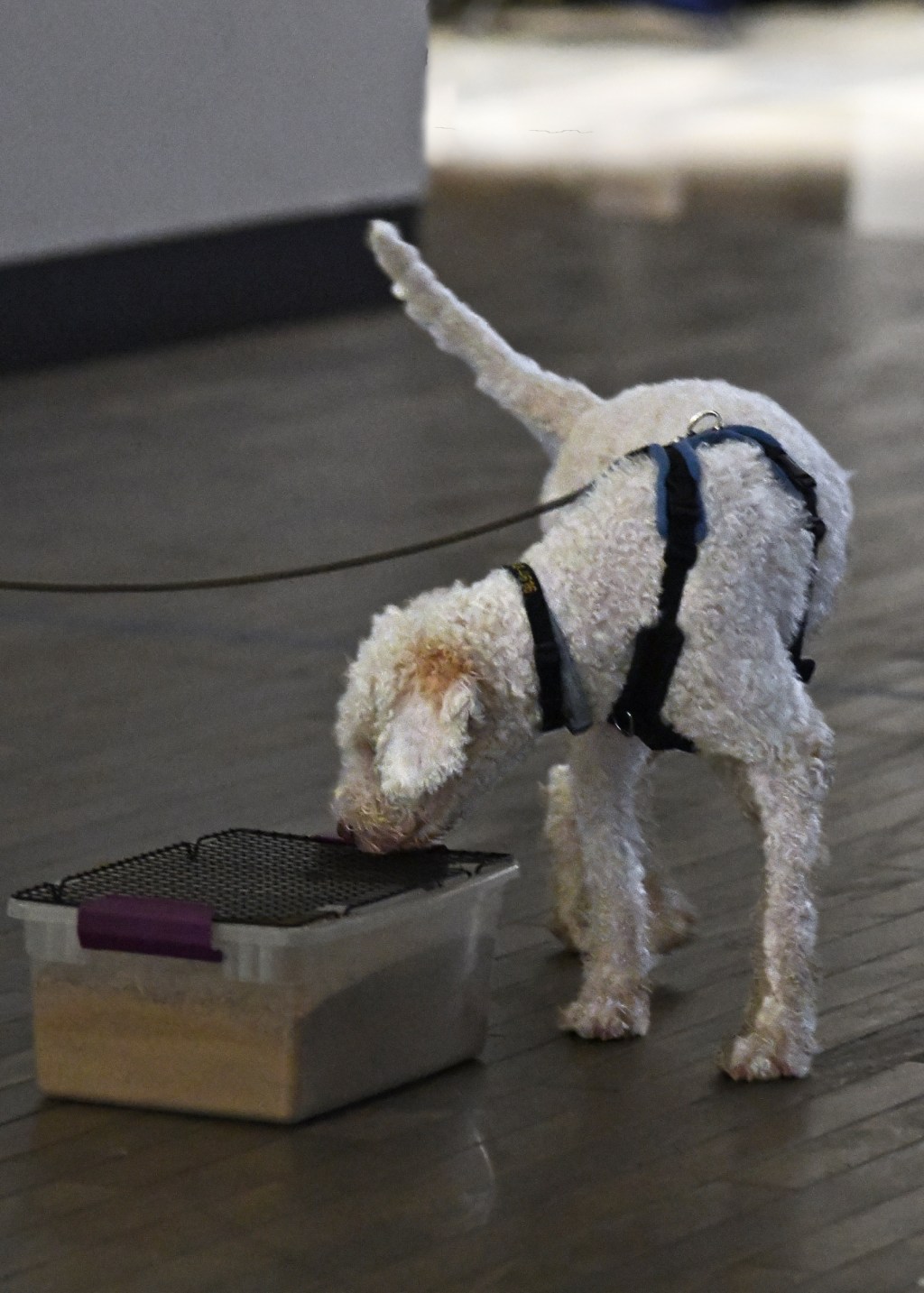
I introduce the glove in a bucket, and reward the dog for sniffing. I don’t expect the dog to alert on the glove, I just mark it (with a clicker, or a “yes!). Once I have done that several times, I introduce a couple of blank gloves, rewarding the dog ONLY for my glove, and then I introduce one and then two, or more “distraction gloves” that have been scented by other people. I like to gradually add more distraction items, but it depends on how the dog is working. I like to use buckets because they concentrate the odor, which I think makes the odor picture a bit clearer. (Yes, the dog will smell the plastic as well, but it is a lower level background odor that I don’t think interferes much.) I play the shell game, moving the buckets around randomly, and allowing the dog to search and get rewarded for sniffing the target glove. The dog will usually start to show recognition of the target glove pretty quickly, either by pausing, or by offering the indication that he gives on essential oils.
Once he is recognizing the glove in the bucket successfully most of the time, I put the gloves in the boxes that will be used in the novice search. I work the boxes open for a few sessions, then for a few sessions with three flaps closed, and if that is successful, then I close the boxes.
Of course, you can do this introduction a variety of ways, as long as you reward the dog for sniffing the correct item.
Introducing the Cotton Ball
I think it is helpful to introduce the cotton ball right away, just after you see that dog recognizing the glove. I am not sure the dog actually connects the scent on the two items, so I find it best to treat it as if it is a different scent, and I work it at the same time as I am training the glove.
I could be wrong here, it is hard to know for sure because we can’t really ask the dog. But when I was training the two items sequentially, I was not seeing any signs that the dog was generalizing from the glove to the cotton ball. Unlike essential oils, the HD scent is more subtle, and the carrier of the scent (glove or cotton ball) is a much larger part of the scent picture. And the glove smells very different than the cotton ball, even to our weak human noses. So I treat the two items as different target odors.
I like to introduce the cotton ball in a ceramic or glass vessel, (I generally go to the dollar store, or Walmart and get 5 or six cheap mugs, but you could also use open mason jars) because the cotton ball has less surface area to hold scent, and is a much smaller target than the glove. Glass or ceramic does not absorb odor like cardboard does, and it concentrates and reflects the odor back at the dog and make it more obvious. Cardboard provides a lot of background noise in the way of different odors that it has absorbed over its life. Of course, if you have a rambunctious dog, glass or ceramic mug might not be feasible, in which case you can use open small Tupperware containers or small buckets.
The Learning Process: Let the Dogs Compare and Contrast
I always do my introduction to a novel target odor off leash, in a familiar environment. It’s important to let the dog work independently, or you risk them misunderstanding what it is you are trying to teach them. In my last blog post I talked about the difference between the HD task and essential oils search: the HD search is a difficult discrimination task, whereas the oil search is more of a broad search and not really a discrimination task.
In human terms: if the HD search were a visual task, it would be like asking someone unfamiliar with apples to distinguish between a Macintosh and a Red Delicious apple. The essential oil search would be more like asking someone to distinguish an apple from a watermelon.
The apple vs. watermelon discrimination task is a broad search task, it is immediately obvious and does not take a lot of thought. But to discriminate two different types of apples a person would probably want to handle both types of apples, turn them over and examine them closely for color difference, size difference, etc. One would want to look at them side by side in order to really compare them. After a person had really studied the differences, and practiced identifying the apples, they would get faster and probably be able to tell the two apples apart very quickly.
For the Handler Discrimination task, the dogs need to do the same thing, only with odor, and to compare the two items properly they usually need to go back and forth between them. I personally love to see the dogs doing this because it means that their brains are engaged and they are actively thinking through the problem. When you see the dog just sitting down very quickly in front of a glove or cotton ball, he is often guessing, and not actually thinking about it. Although, different dogs learn at different rates, and I have seen some dogs pick up the handler’s scent very quickly.
Eventually, when the dogs have enough practice, they will start making decisions quicker, and will work the boxes more methodically. You can usually see them notice the distraction item –sniff a box slightly longer, but not alert and continue to search.
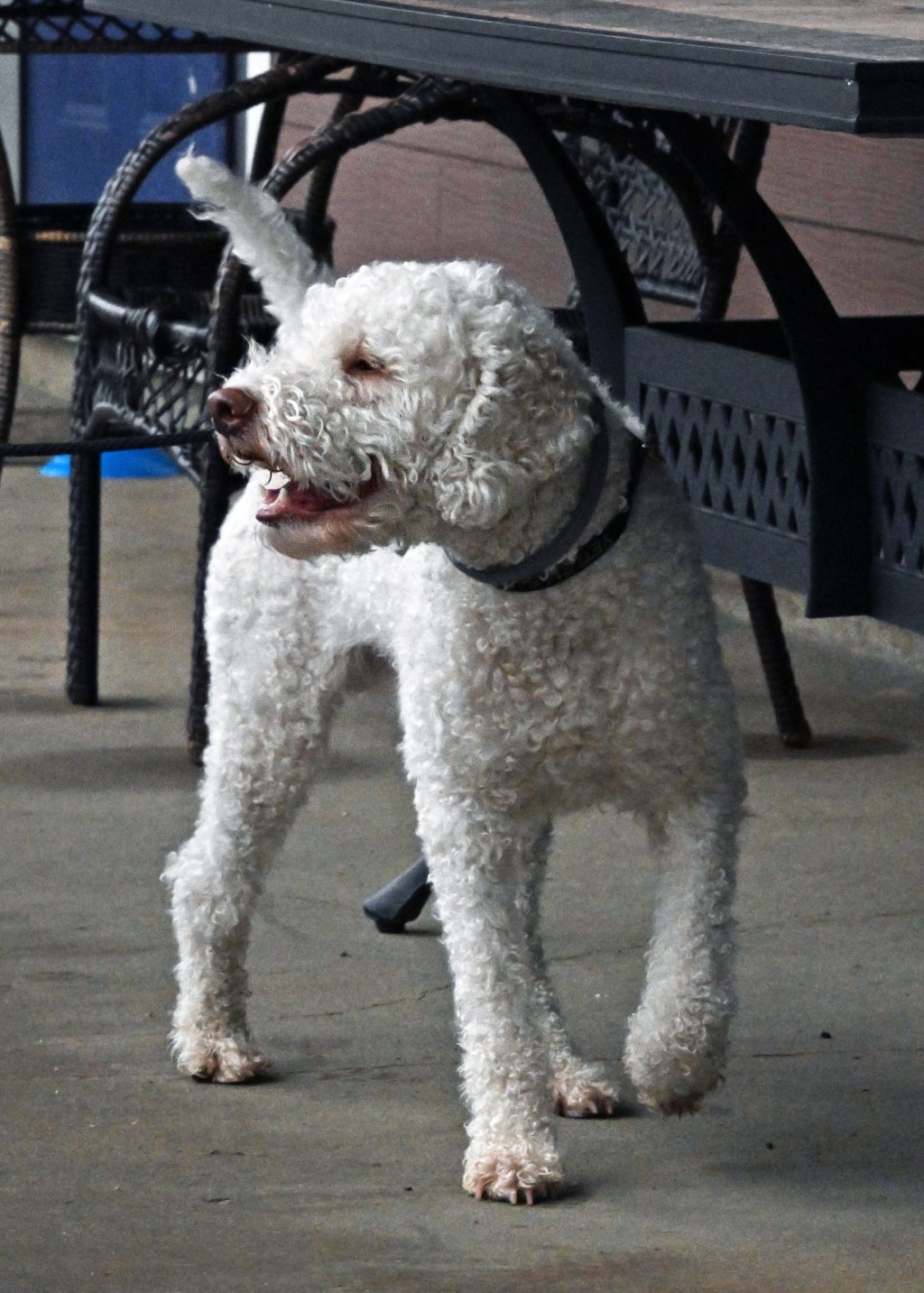
Here is Yeti in a Novice HD search—he has gotten past the comparison stage, but he goes much more slowly than he does in an essential oil search.
Proofing the Distraction Cotton Ball
By far, the thing that I have found that makes the biggest difference in getting the dogs to really understand the HD element is proofing the distraction item. By “proofing,” I mean setting the dog up to fail by putting out ONLY the distraction item in the search area. Usually the dogs have generalized alerting to any cotton ball, and therefore will alert on the distraction cotton ball. You can teach them that that is not the item you want them to look for by not giving them a reward, and maybe a gentle negative marker, like “uh oh, that’s not what we are looking for!” and then stopping the search.
I pair the “proofing” search with another search with only my target scent item out, so that they can be successful, and give them a chance to compare and contrast the two searches: in one, the dog alerts on a cotton ball, and in another, the dog does not. The difference is the odor ON the cotton ball.
Depending on the dog, I will do these two scenarios several times. After a few unsuccessful searches, the dog will usually figure out that you don’t want them to alert on ANY cotton ball. You need to make sure that you are using at least three different distraction cotton balls (that is, cotton balls that have been scented by three different people) so that the dog will generalize not alerting on the “other” cotton ball. If you use only one distraction cotton ball, (say, your husband’s) the dog might think that you want him NOT to alert on your husband’s , but maybe you do want him to alert on the cotton ball that someone else has scented.
After doing contrasting searches with distraction and target cotton ball, I will introduce a search with both items out. You should be able to see your dog noticing the distraction cotton ball, but not stopping and indicating.
To test if the dog really understands the concept, you can hide your target cotton ball in a very difficult spot, and put the distraction cotton ball in a very easy place for the dog to find. This should push them to really search hard for the target cotton ball.
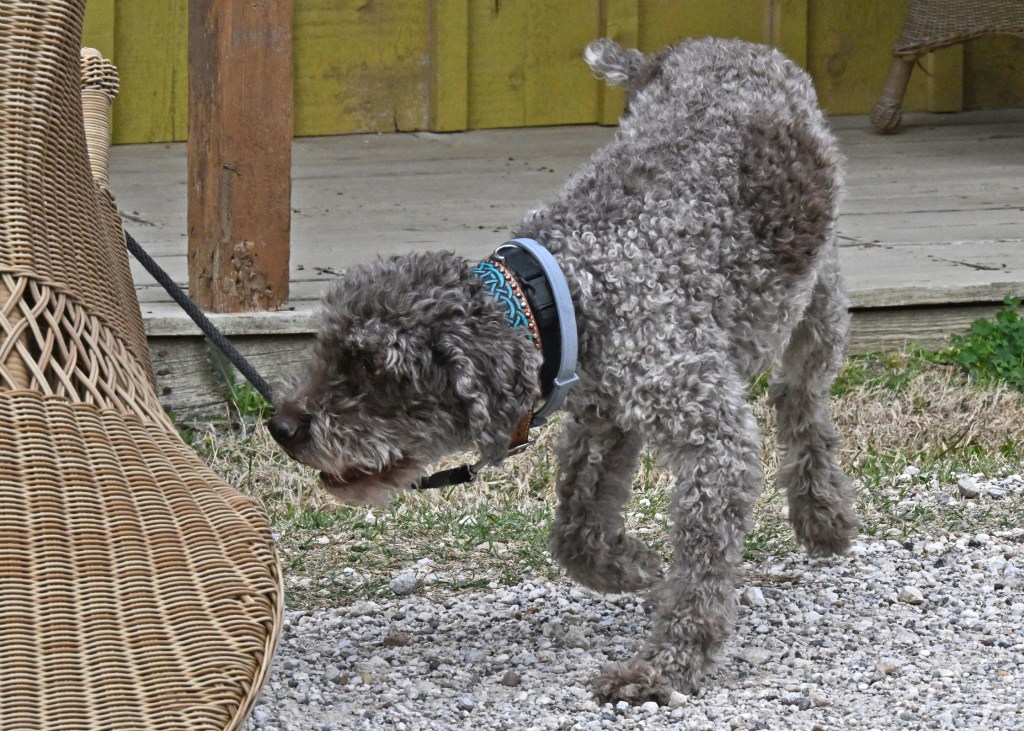
Astra was really stuck at one point, while working the cotton ball outside, and I tried several things that were unsuccessful, before hitting on proofing the distraction cotton ball. Once I set up several proofing situations, she seemed to really get it, and you could see her find and then pass over the distraction item during the search.
WARNING: this proofing exercise is essentially a blank, or unproductive, search. If you have never done blank searches with your dog, then I suggest you get some guidance on how to start them, and maybe practice them without a distraction item first. The blank search is a whole training topic by itself, and I am not going to discuss it here.
The last piece of advice I will give is to keep a record of your training sessions, so you can track the success rates, and trial only when you are ready!
Want to get these posts delivered to your email? Click on the Home button on the left, scroll down to the bottom and put your email in the SUBSCRIBE box.


 Sniffing Around Scent Work
Leave a reply to Lisa C DeHart Cancel reply