
I have been thinking a lot about balance.
Partly because I have a puppy, and I want to do my training differently this time. And partly because I am older now, and I have learned more about trying to balance my life in general, and I have decided that balance is pretty much the key to happiness. The truth about everything generally lays, not on the extremes, but somewhere in the middle.
I am a bit of an intensity junkie. I like to dive in and explore to the outer edges, immerse myself in learning a subject or working on something until I have really squeezed all the juice out of it.
This is not a good approach when it comes to dog training, and nosework in particular. In the distant past, when I was training for obedience competition, I learned the balance thing training the drop on recall.(Note: for those of you who haven’t competed in AKC obedience, the drop on recall is an exercise in which you tell the dog to sit and stay, walk about 20 feet away, and tell the dog to come. When the dog is about half way to you, you tell the dog to lie down, and he is supposed to stop and down immediately. Then you tell the dog to come, and he comes and sits in front of you and on command, moves to the heel position).
If you always give the down command, you get a dog who anticipates the drop and slows down to a crawl, or downs prematurely. If you don’t drop the dog often enough, it tends to run through the down command. The best approach, I found, was to drop the dogs sometimes. And to sometimes go out and just treat the dog for downing and not completing the front and finish for that exercise. And sometimes to just let the dog come to you and get a reward.
I would guess that it applies to all dog training in one way or another….but when training my first nosework dog, Riley, I had to figure it out the hard way.
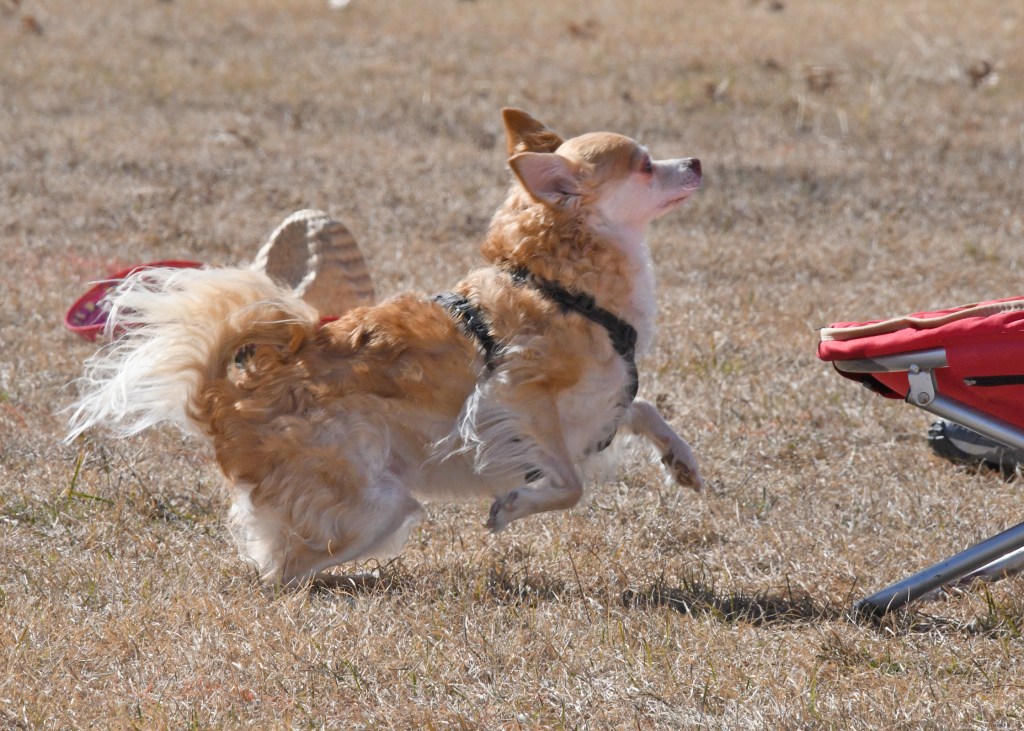
We first trialed in the UKC venue, because those were the trials being held in my area (AKC did not have a program yet, and NACSW were not holding many trials). And we trained to the levels and tests written into the rules, because we really didn’t know any better, and had to start somewhere.
The rules at that time didn’t have an unknown number of hides included in any level. So, you always knew how many hides were in an area, and therefore you always knew when you were done. Seems very straightforward. BUT….
This approach led to an over-reliance on the dog’s formal trained alert, and the handler’s knowledge of the number of hides. We didn’t learn how to read our dog’s body language because we didn’t have to, we always knew when to stop—after the last hide. We didn’t know what the dog looked like when he was done searching the area, we didn’t have full communication.
It also led to a big training issue: the dog felt like he had to give an alert every time we searched an area, whether there was a hide there or not. And this led to a lot of false alerts when the dog got frustrated. I think the dogs figured it was the only thing they could do to stop a search, or they just got in the habit of alerting after a certain amount of time, or they just thought the handler would be happy when they gave the signal. Our education of exactly what we wanted from our dogs had been lacking. We had only given them one side of the equation.
After I got Astra (who I picked out specifically for scent work) I figured out that I needed to train blanks (areas where there is no target odor, and therefore nothing for the dog to alert on), and I needed to do it on a regular basis.
And here is where the balance factor came in: I overcorrected for my previous training errors in NEVER training blanks, and now I trained blanks too much. I figured out that in smallish areas, that were not too cluttered, Astra knew very quickly that there was no target odor. And I rewarded her for a specific behavior, a bounce and look at me.
[Yes, I reward blank searches. I know not everyone does, and I am not saying that this is the only way to train. I just feel that if the dog has searched thoroughly and not given me a false alert, that there should be a reward. This approach has its problems—it may lead to some false negatives –the signal that the area is blank when it is not. But not rewarding the blank search can lead to false positives—getting false alerts when the area is blank. Life is complicated, and again it’s a matter of balance.]
So, I got overconfident and trained too many blank areas. And when we started competing in the Masters level in AKC, we had to call three rooms correctly, with possible blanks (areas with no hides). And we failed and failed and failed. I pretty quickly figured out that I had worked on too many blanks, and rewarded too quickly. This led to very superficial, sloppy searches. She was missing hides she should have caught. And it was a painful error to fix. We had stop working blanks at all, for quite a while, and then I had to be careful about how I rewarded her.
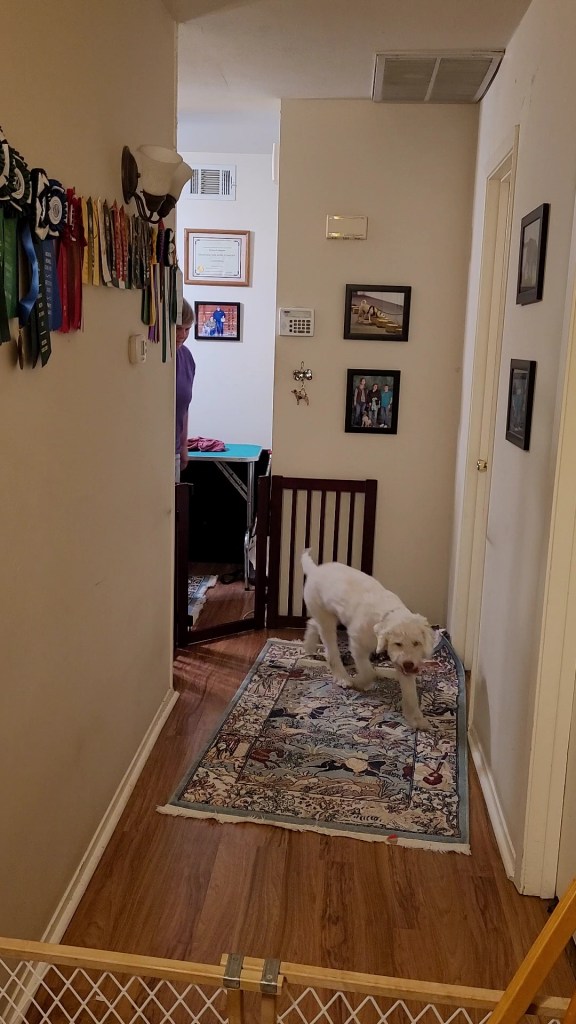
Now, fast forward to the present. Here I am with a brand new dog, chock full of puppy potential. I am super aware of the need to balance his training…and also very aware that there is no perfect system, and that I will fail in some way, will inevitably make some mistake by overcorrecting a past mistake.
But I am hoping it will be a smaller over correction this time.
And in that vein, I am trying not to do too much of any one thing with Yeti. I am trying not to work any one element too much (especially boxes, because I suspect he is already bored with boxes), trying not to over emphasize the final trained alert (because finding the odor is more important), trying to always reward BIG in training, to encourage his drive…and I have introduced blank searches early.
So far, I might be doing ok. Hope springs eternal…..
To get these posts in your email click on Home and scroll down to the SUBSCRIBE box at the bottom of the page


 Sniffing Around Scent Work
Leave a reply to ellenheavner Cancel reply