Feb. 24, 2022
When I was in my 20s and 30s, I thought that cooking meant following a recipe.. Of course, I was the daughter of a mother who came of age in the 1950s, the decade of processed food, who really hated to cook, at that. So I didn’t have much exposure to creative cooking, by someone who knew about the principles of cooking and knew about combining flavors, etc. until well into middle age, when I had a boyfriend who was an artist in the kitchen. Boyfriend despised processed food and scoffed at recipes, though he would study menus like they were ancient scrolls, poring over them for ideas. I learned a lot vicariously about cooking by watching him work, and by eating his food. And I learned that you can be creative with cooking – that you don’t have to be bound by the recipe.
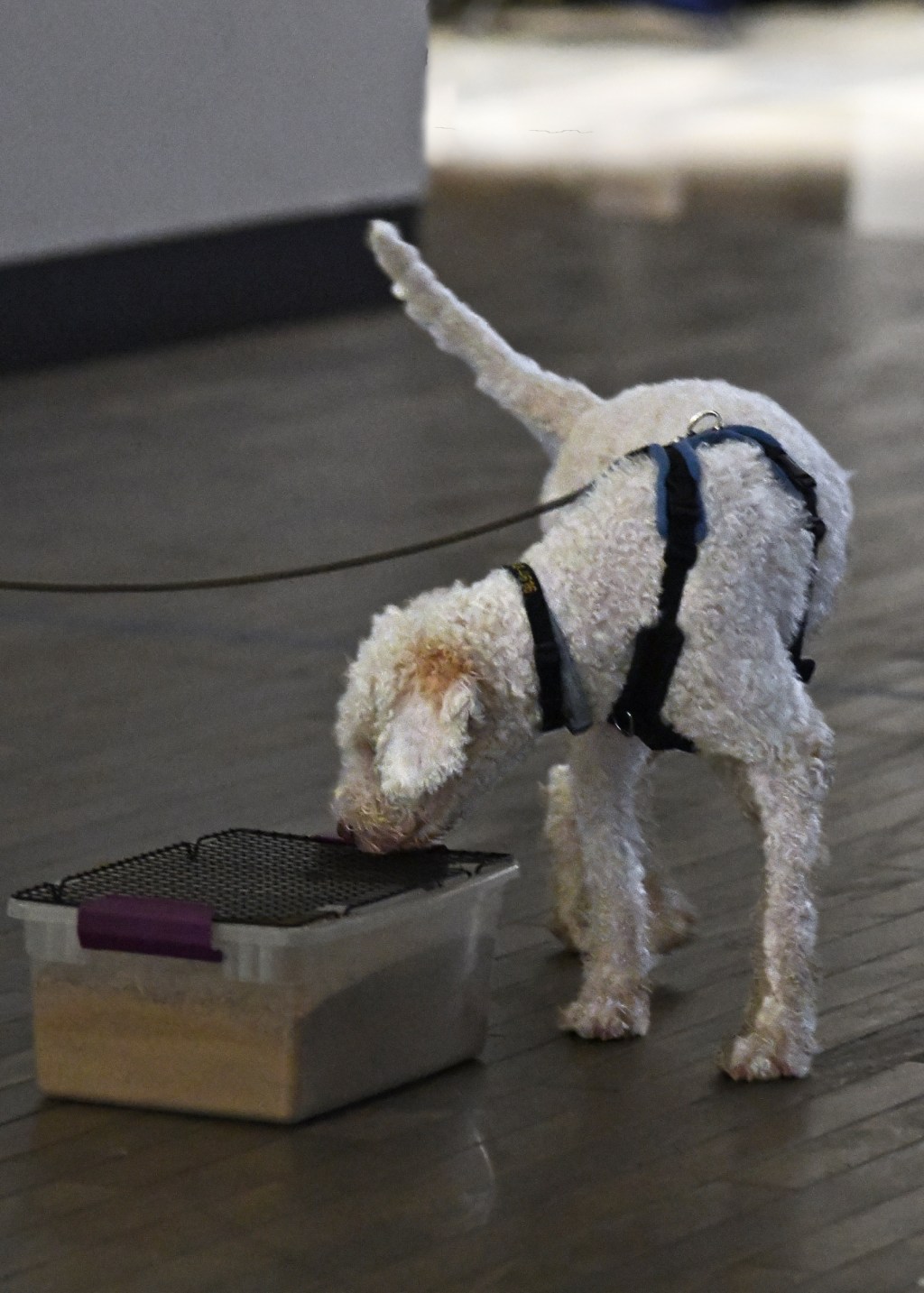
I feel much the same way about scent training these days. A recipe is a fine place to start, if you are new to the sport, but I think that you and the dog benefit by figuring out principles, watching other people and other disciplines, and trying new things.
One of the benefits of a puppy is that it gives you a new start, and inspiration to try other techniques in training. And one of the benefits of Yeti, is that he is smart and that keeps me jumping.
I decided to introduce him to the vehicles element the other day. (For those of you uninitiated into nosework, that means, the competition element where a target odor (q tip with essential oil on it) is hidden somewhere on the outside of a vehicle. It might be tucked into a door seam, or stuck underneath a running board).
He has a good nose, but it didn’t go as I had hoped (does anything ever in my life???). He was, like many dogs, not interested in sniffing around the car, the way I wanted him to. Why should he be, after all? He is used to getting in and out of the car, and has no reason to think that I would want him to sniff around outside of it.
My usual method for introducing the vehicle element is an exercise called “chase the bunny.” This recipe was passed down to me by trainers of drug dogs, and as far as I can tell, has been used for a long time. You place the tin (that contains the q tip) on the back or front of the car, about at nose height, and tell the dog to find it, and wait until they happen across it, then mark and reward the dog. And then, you move the tin a little bit (six inches or a foot) down the bumper, start the dog again, mark and reward, and repeat and repeat and repeat. Eventually the dog figures out that the car is an object of interest, and he should search that to find the target odo (and therefore, the reward). If you do this very systematically, you can teach a pattern search, but I don’t find those of use in competition, so I don’t usually go that far.
My other personal nosework dogs had been on odor for quite a while before they got introduced to the vehicle search, so they were pretty quick to figure out the car was the thing to search. But they weren’t puppies.
In my first training session with Yeti, he looked EVERYWHERE except on the car, even when we were close to it. After all, the world is a FASCINATING place! SO MUCH to look at! SO MUCH to sniff!! It took him so long to find the hide that I nearly gave up.
I have run into this when teaching classes, and I usually just wait the dog out. The dogs will get it eventually—the hardest part of the exercise is not letting the handlers point at the hide. But the next day, I had an inspiration, a possible short cut.
All dogs, even the dogs who are bred specifically to use their nose, search with their eyes first. Hunters know this, and will teach their dogs the retrieve letting their dogs watch the bird or dummy fall, and then eventually sending them to retrieve the object without having seen it thrown.
When I first got Yeti, I wanted to have him hunt for his kibble (this is a fun game for puppies), but the first time I tried it, he didn’t know to use his nose. So I had him watch me hide it once, while he sat in his kennel, and when I let him loose, he looked in all the places he had seen me put it. After that whenever he heard kibble hit the floor in the big room, his nose automatically turned on to tell him where the it was.
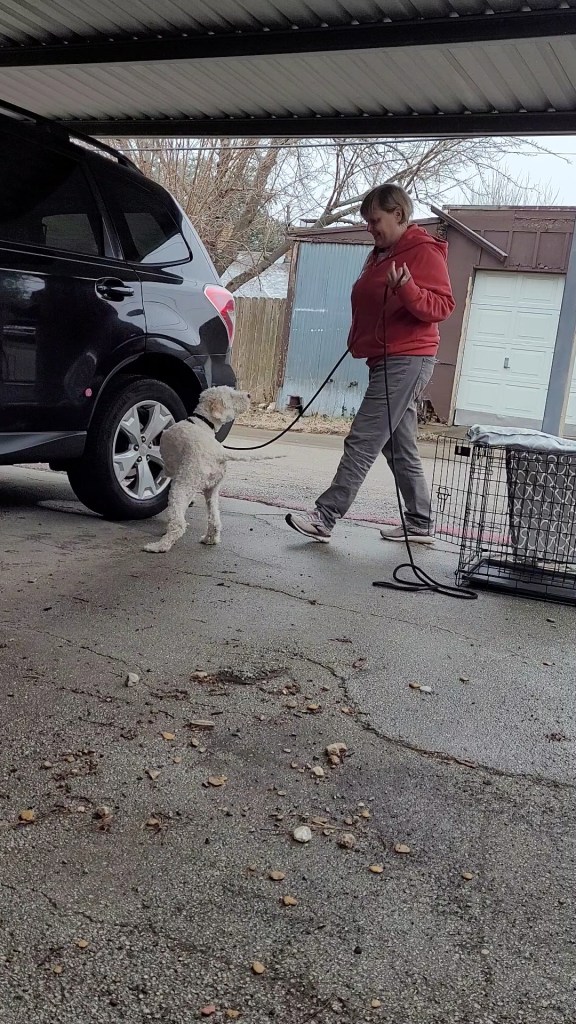
So the next time we went out to search the car, I brought the kennel out with us. I put him in there, and let him watch me stick the hide on the car, and then I got him out and told him to seek. He did beautifully, going almost right to the hide. We did a couple of repetitions like this.
Then I put Yeti in the kennel, but covered it so he couldn’t see what I was doing. I put the hide on the car, got Yeti out and told him to seek. He was a bit distracted, but only for a few seconds; we were making progress, and that is pretty much all you can ask of an 8 month old puppy.

I am calling it a win, And I have filed away this trick to use in future classes. It might not help with every dog, but I love collecting the little tools and tricks that might help the next class along.
Want to see? I captured some of it on video, complete with botched leash handling…and it’s on YouTube: https://www.youtube.com/shorts/KagVqfmv8E8

 Sniffing Around Scent Work
Leave a reply to Pat Roddy Cancel reply