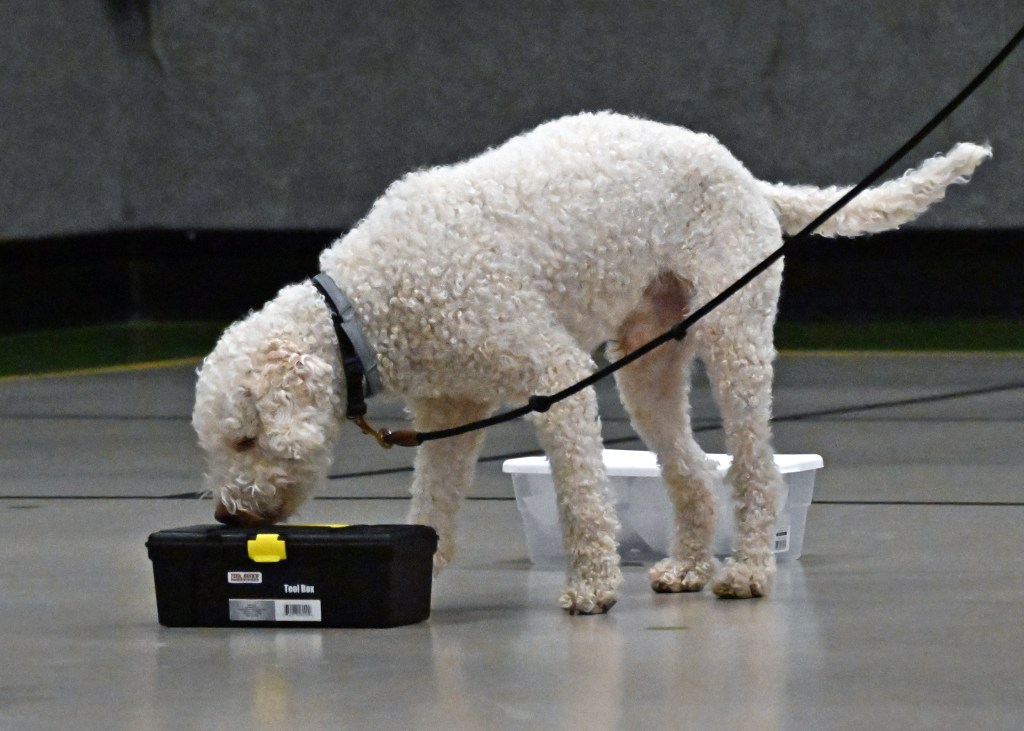
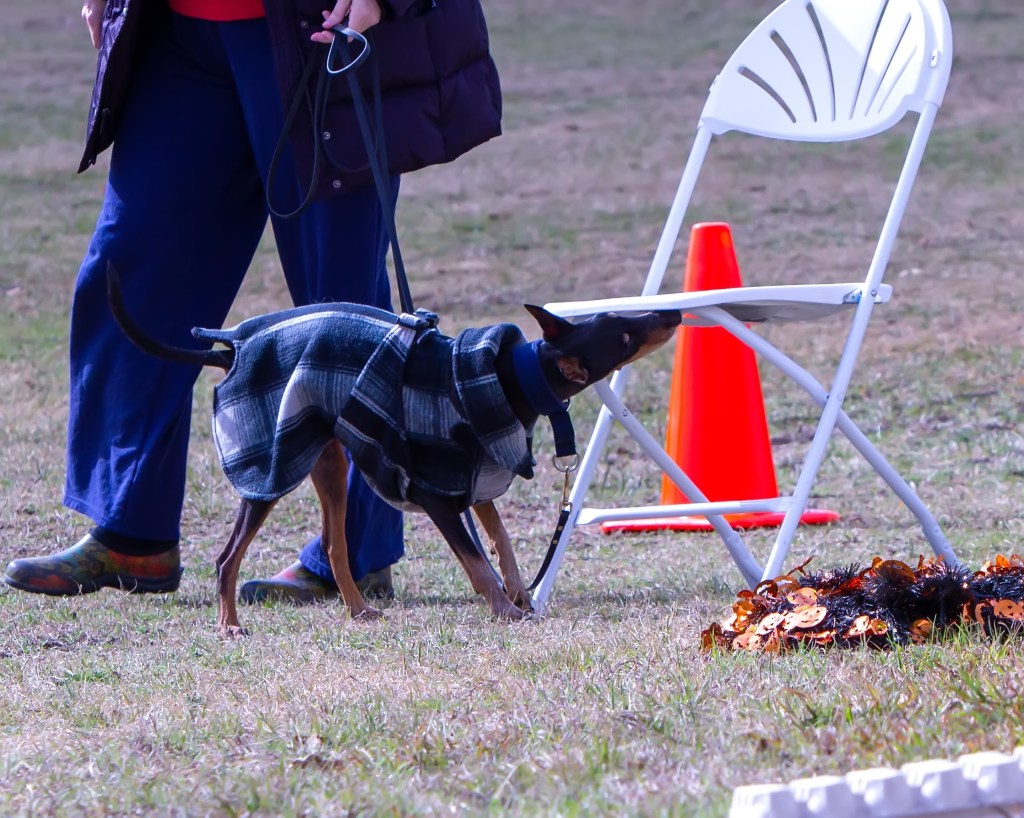
At a trial last spring, I watched a dog struggle in advanced containers. She was a young terrier who was an enthusiastic worker, but was clearly struggling in containers. The 15 containers were in two rows, and were the usual mix of plastic toolboxes, cardboard boxes, and some small backpacks. The handler had shortened the leash, and every time they went around the containers, she walked a little faster, chirping, “search, search!” at regular intervals. The dog was sniffing, and finally on the third round, alerted correctly on a box, but then sniffed right over the hot backpack without any sign of recognizing odor. The timer finally called “time” and the dejected pair left the area.
I knew this handler slightly; I had run into her in a few trials and we had chatted casually. I saw her later, and she said to me “I just don’t understand…Lulu usually does so well at containers! We are running in Master containers in UKC, but we have failed in the last three AKC trials.”
The problem here? Not all containers are alike. There is a world of difference between UKC and AKC container. I don’t know where Lulu and her handler train, but I am guessing that they have not had proper introductions to the types of containers used in AKC trials.
In my post last month (Containers Part One), I talked about boxes, which are the foundation containers that we start our dogs with. In UKC, containers are always boxes, and they are the easiest type of box: the ones with the fold-over tops, and there is usually a small gap at the top of the box where the odor escapes.
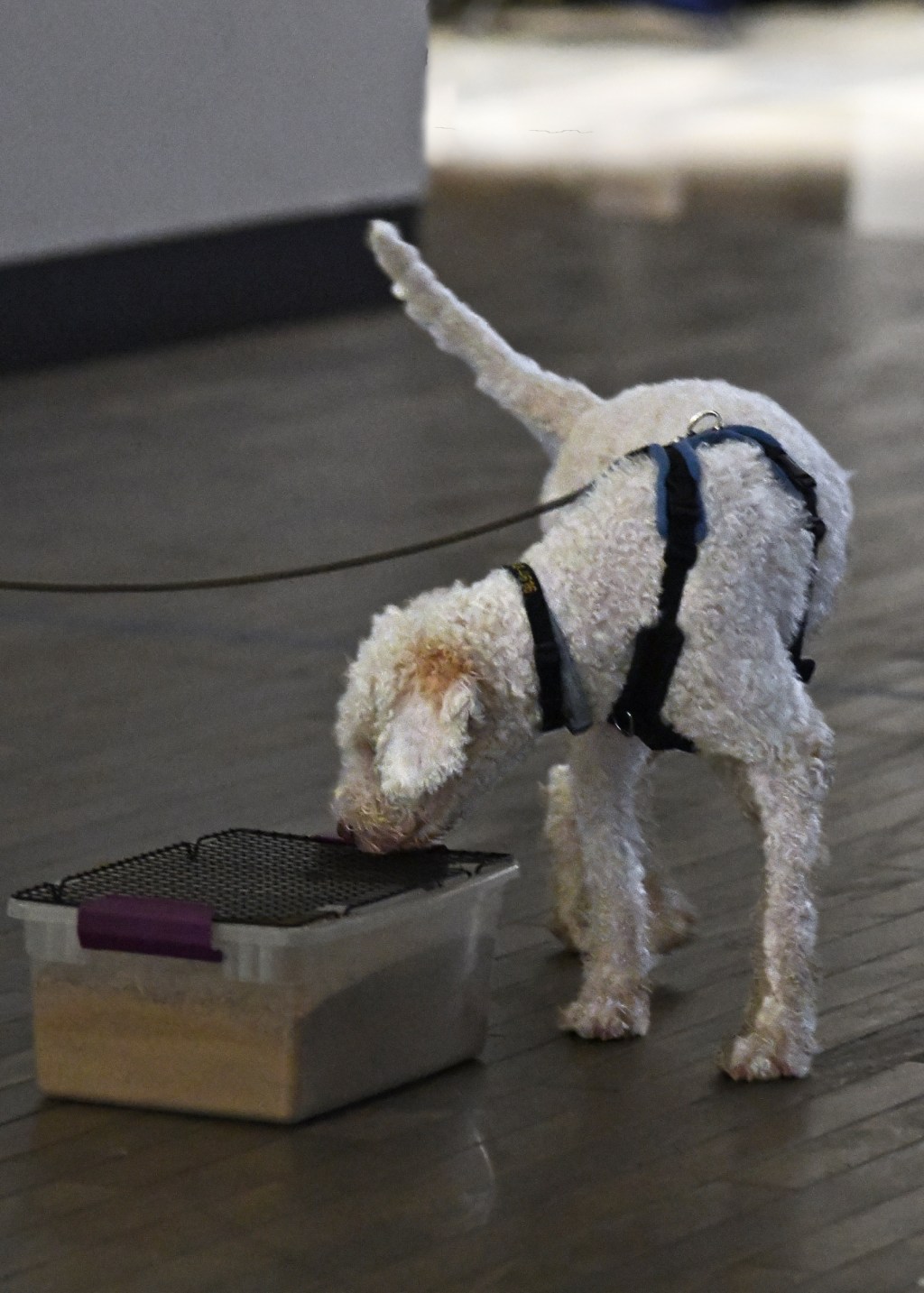
In AKC, containers are boxes only at the novice level. At all the other levels, the containers are of “variety” of types. The regulations do not specify exact types of containers, but what you typically see at trials are cardboard and plastic boxes and bins, metal tins or paint cans, and backpacks or duffel bags.
These are generally more challenging than boxes. If your dog rocked Novice containers, and you move her up to the Advanced level without any preparation on other types of containers, you are likely to be disappointed.
Fabric bags
We never worry about waiting after we put odor in boxes, we just slap the odor vessel in the box and throw it down, and voila, the dog finds it. However, if you do that with a backpack, the dog is likely to sniff right over it, without any sign of encountering odor.
In fabric containers the odor is absorbed by the fabric, just like water dripping on a towel will be absorbed by the terry cloth. The odor will eventually soak through the material and spill out the zippered openings, but this takes time. This is called “aging” the hide.
The amount of time you need to age depends on the material and construction of the container. Generally, for a small backpack that is made of that canvas-like material, you can get away with aging it a half hour to forty minutes. For the flimsy string and nylon type bags, you can get away with a few minutes (warning: your milage may vary!). For bags that are designed to be waterproof, like cooler bags or some lunch bags, it will take much longer, and in general less odor will escape because those bags are designed more tightly.
You can have the dog search an unaged fabric bag by leaving it open, and placing the vessel near the opening, so that the odor can spill out of the bag easily. This makes the odor freely accessible to the dog. However, you have to be careful to fasten the scent vessel down somehow, as the dogs will often knock the vessel around while trying to find it, and then it gets misplaced, or becomes inaccessible if it is knocked to the back of the bag.
Metal
Metal containers, which in searches are generally paint cans or cookie tins, should always have holes punched into them to let the odor escape. These are designed to be airtight, so if there are no holes, the odor does not readily escape. The challenge with metal containers is that odor particles stick to metal more than any other material. My dogs have a history of falsing on metal tins if they are next to, say, a hot cardboard box, because the odor will drift to the tin and stick there, and the dog will mistake it for source. However, many dogs have no problem with the metal and will alert on them readily.
Plastic
Of all the containers, plastic is probably the easiest. We don’t start with plastic boxes probably because of tradition. Plastic doesn’t absorb odor the way that cardboard or fabric does (at least, not for a very long time, unless oil actually contacts the plastic), and the odor escapes mostly from the seams. How much odor will escape, and how fast, depends on how well the container is constructed. For very sturdy plastic containers with tight seals, very little odor will escape.
The plastic containers that we see in trials are generally pretty flimsy: the dollar store toolboxes, plastic shoeboxes, etc. so there is usually a fair amount of odor escaping, through the top holes where the handle is attached or around the seams. Once the dogs learn how to work these, you can see them sniffing around the edges where the seams are.
Training Different Types of Containers
Introduction is crucial. In general, when I am introducing any unfamiliar container to green dogs, I don’t wait for them to alert, I mark and reward when they are sniffing the hot item. The odor contained in a fabric or metal or plastic bag smells different to them than regular “box” odor, and the odor picture is different. After a few repetitions, they start to understand the how to work this particular picture and will start alerting on their own.
If you don’t do this, and expect the dog to alert as quickly as they normally do, or worse, you get impatient and start standing over the container saying “search! search!” or pointing at the container, then you risk the dog thinking that you don’t really want him to look for odor. The odor is probably not hitting him in the face that it usually does, and it undoubtedly smells different. He is trying to find the odor the way he usually does, but he needs more time, and clearly you are upset. He may start just looking at you for clues as to what you want. Now you are in a situation where the dog looks like he is sniffing for odor but he is actually just watching you for a cue to give his alert: the perfect recipe for getting false alerts.
And typically containers is the element where the most false alerts occur. Partly because dogs have the odor is inaccessible, and partly because there are a lot of handling errors in this element. I will be discussing handling in my next post! Stay tuned!
Have you signed up to get posts delivered directly to email? I am no longer putting all my posts on Facebook. Scroll up to the top (or down to the bottom if you are on a mobile device) and put your email in the black box.



 Sniffing Around Scent Work
Leave a comment