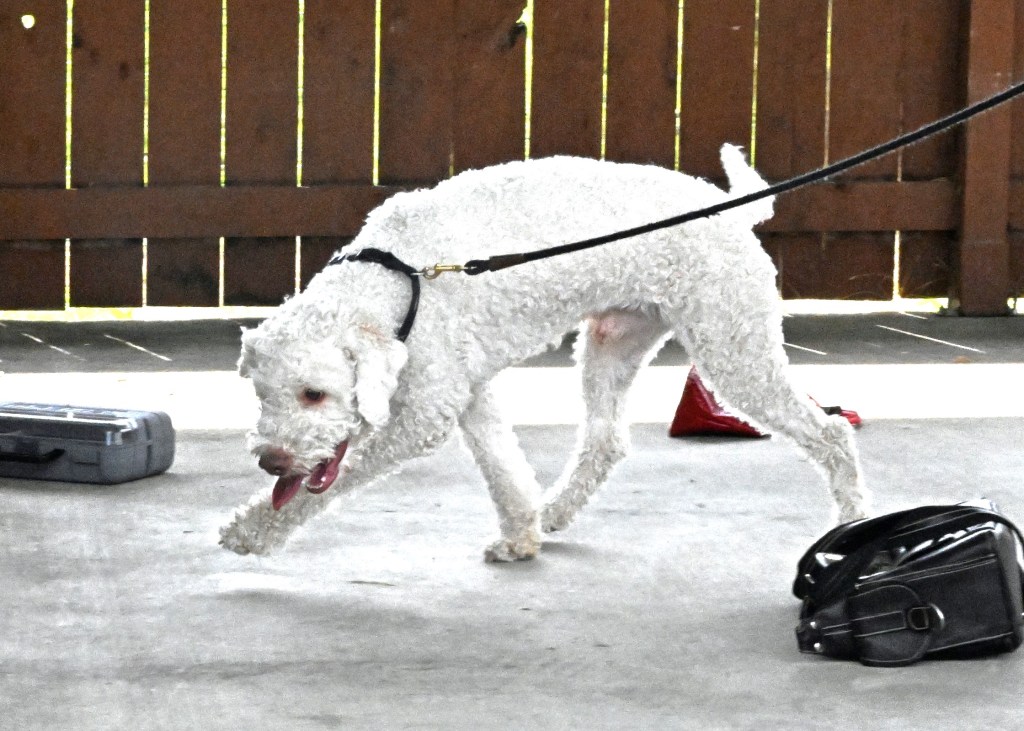
This is the scenario at just about every AKC trial I attend: there is a general briefing, announcements, judges’ comments, and then everyone splits up to go look at the search areas before the judging begins. And, inevitably, the areas that people crowd to go to look at are the interiors, and exteriors and detective. If you happen to go over to the container area, there are usually not very many people there. The ones who are there take a quick glance and leave.
There are good reasons for this: there is not a lot of flexibility in the rules for containers, the times are pre-defined, there are only a few choices for arrangement and the number of containers never vary. So what is there to look at? It makes way more sense to go look at the areas where there is a huge amount of variation, so you know what you will be facing on the start line.
And truthfully, this has always been my approach also. Until last spring.
I did not go to the containers briefing. And when it was my turn, I stepped up to the Masters Container field, full of hope and trepidation. I knew Yeti could do AKC containers, but I also knew that he had been very inconsistent in this element.
And if I had gone to the briefing, or if I had just paused on the start line long enough and really looked at the containers, I would have seen that:
- With the exception of two suitcases (which I knew that this judge would not use for odor), these were all easy plastic or cardboard containers, things that Yeti was familiar with and could easily make a snap decision about whether there was odor present or now.
- There was only one distraction in the search field. I know full well that there are three distractions required by the rules at this level. That meant that there were two distractions inside containers. AKC rules are particularly vague when it comes to distractions—they can be clearly visible to the handler and dog, or they can be hidden inside containers.
- Although the containers were set out in four rows, there was plenty of space between each container, much more than the twelve inches required by the rules. Yeti has a lot of trouble with convergence of odor (odor traveling from a hot container to a cold one), and this spacing would minimize the amount of convergence present.
- There were no really flat containers that might have been more difficult to sniff. All of the containers were more or less tall.
What I should have seen was an easy container search that Yeti wouldn’t have any problems with, although he would probably show some interest in the distractions in the containers.
Instead I just saw a big containers field and assumed that he would have trouble with the search. We had been practicing with a lot of fabric containers, like backpacks, and Yeti had been missing hides in those searches. In searches where the containers had been easy –plastic and cardboard—Yeti had consistently been finding all the hides easily.
I was stuck inside my head in my past practice sessions and not observing things in the moment. This is what costs you Qs, way more than training errors, or mistakes your dog makes.
And we failed this search, because I failed to be a good team member, and did not make the observations that would have helped us finish this run successfully.
I am embedding the video of our run below.
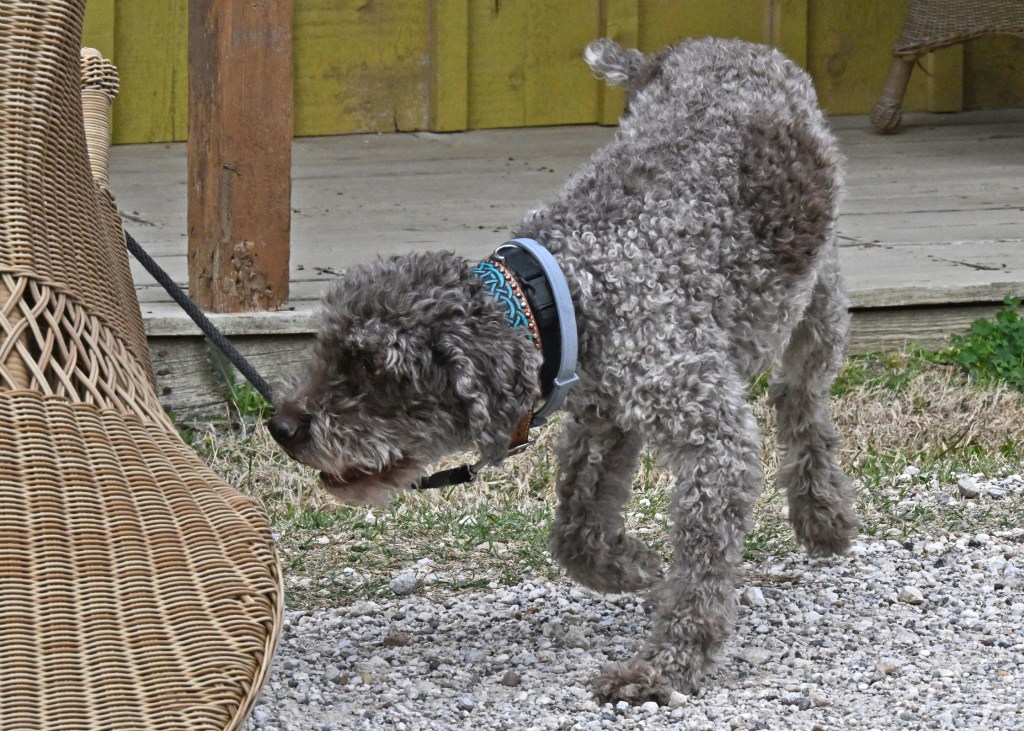
Yeti starts out as he usually does, taking a sweep around the field and doing an inventory, in particular, noting where the distractions are—he shows me the rope toy, and then goes to that black container on the end, and I get a questioning look. That is him saying, “there’s a strong smell here, did you want to know about it?” and when I don’t react, he moves on, and goes right to the container with the hide, and alerts.
As it turns out, that was the only hide there, and he knew it. Unfortunately I wasn’t able to figure that out, because I was thinking about past practice searches with backpacks. Argh. To Yeti’s credit, he dutifully kept going, looking at me every few seconds to protest. Because of my misconceptions, I pushed him to search for way too long, until he finally gave me a frustration alert on the container with the distraction in it.
Know your dog’s strengths and weaknesses, and know their patterns. Know what you need to look for in the search in order to help him or her.
And above all: learn, unlearn, relearn.
Want to get these posts delivered to your email? Click on the HOME button on the left, scroll down to the bottom and put your email in the SUBSCRIBE box.



 Sniffing Around Scent Work
Leave a comment