June 14, 2024
I want to preface this post with the caveat that I have the greatest
respect for the folks who volunteer to chair a trial or work on a trial
committee. It can be a difficult, thankless job, and it very, very tough to find
good venues that will meet all the criteria to hold a good scent work trial. You
good people have my thanks for doing this work and making this game possible.
I had a conversation with a trial chair the other day, regarding a judging assignment I had accepted.
We were talking about the element assignments for the judges, and she asked if it would be ok if I judged buried on the first day.
“Are you going to put buried in the same area you used last year? (I had competed at this venue last year).
“Yes,” said the chair “in that covered area.”
“uh….is there another area we could use?”
“I don’t think so….why?”
A very good question, and in my quest to educate everyone in the world about the buried element, I am going to answer it at length.
The area in question is under a roof, with walls on two sides, but is open air. It is used for storage. It has open metal shelves on both sides, and these shelves are stacked with various flotsam and jetsam—metal cooking pans, racks, cans, utensils. The buried bins are put in the center area.
The problem with this area is that (as I have discussed at length in other posts — More About the Buried Element,
What You Don’t Understand About the Buried Element , What You Don’t Understand About the Buried Element Part Two, and What You Don’t Understand About the Buried Element Part three –click on those links if you haven’t read these)
the odor is not confined to the bins. It moves very actively, and gets caught up in the nooks and crannies of the stuff on the storage shelves.
If your dog is actively following odor he/she is going to get caught up trying to disentangle the stream of odor in the piles of junk. This will cost valuable time and effort in the search, and will cause many handlers to nag or pull their dogs off the odor and back to the bins….which will, in turn, often cause falsing, as the dogs feel the pressure to get the find quickly but are not allowed to follow the odor naturally.
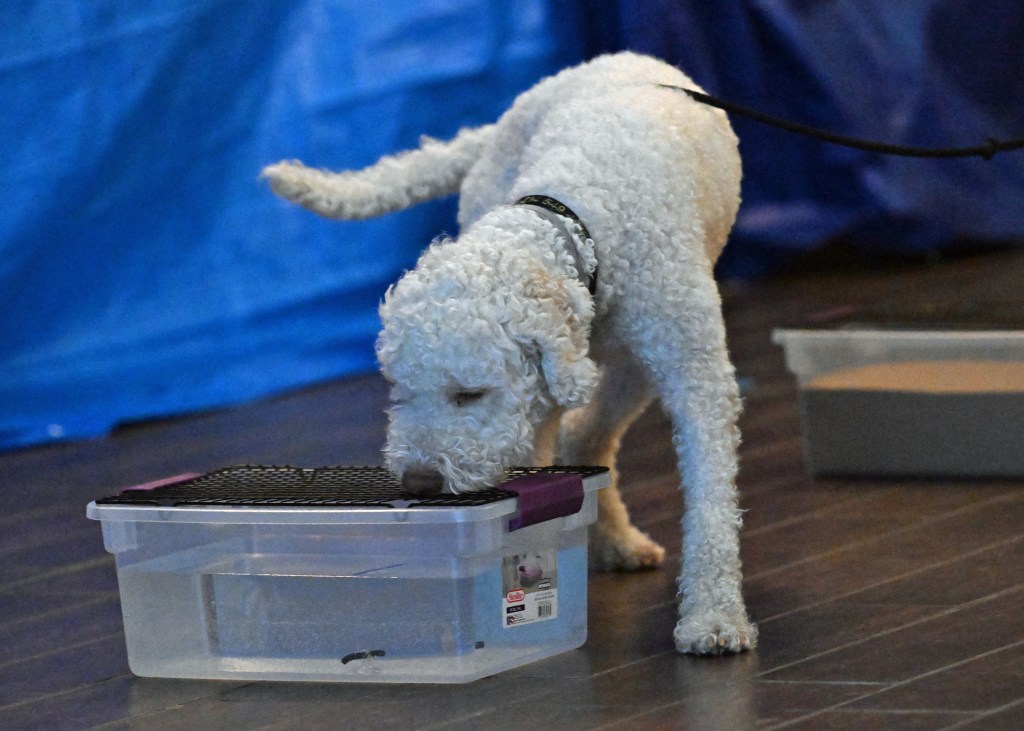
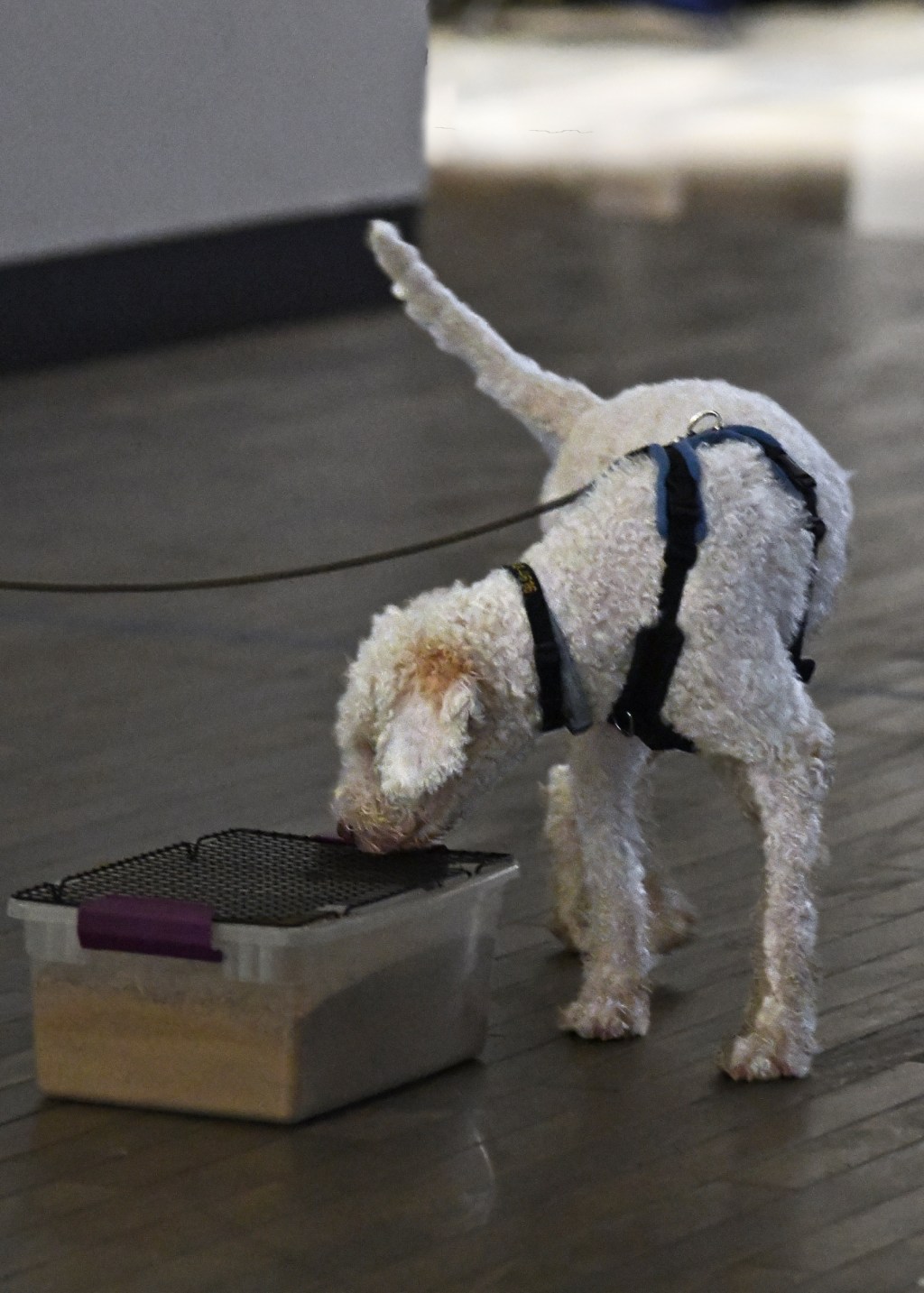
I am inserting a video of Astra working some buried bins in a cluttered room (below). This is a very difficult search. There are three hides here, in eight bins, all of which contain water. That adds up to a LOT of odor in a very small space, and there are a lot of objects for that odor to get caught in. The hot containers are the first one on the left, and the third and fourth containers on the right.
I don’t have the screens on the bins, so Astra does have the advantage of being able to put her nose down close to the water, but in this case it doesn’t help much.
You can see her dip her head right over the hot containers on the right without giving her alert. Instead, she checks the other bins, or she goes back to the “easy” hide (the one she alerts on first) to anchor herself, or she goes over to the wall on the left and sniffs through the stuff piled up there. She is actively disentangling the mixed odor plumes in order to identify the correct sources.
Astra is normally a very competent buried searcher. In an area with less clutter, she would normally do one survey round, and then start identifying and indicating on the hot bins. In this environment she has to go around and around, checking and rechecking and doing a lot of extra work to find the hot bins.
This type of cluttered area might not be such a problem if dogs were used to searching this type of area. Then they would have the opportunity to get faster at working through this type of odor picture. But most dogs are practicing buried in a much more open environment—outside in a yard, a parking lot or in the middle of a big open space training area, where there are not a lot of objects. This also would not be a problem if this were NOT a timed search. The dogs could spend all the time they wanted detailing the shelves and following the flow of the odor stream.
Now there are dogs who will work the containers more directly. Sometimes this is the result of experience: after a certain amount of trial and error, they will learn to target the containers visually and be able to source odor in the container quickly. Sometimes this is the result of a more direct style of working odor, they don’t follow all of the curves of the odor cone. And sometimes this is a matter of conditions: I have judged trials where virtually all of the dogs worked very close to the containers. But these are exceptions rather than the rule.
WHAT TO DO…if you are trial chair/committee member and you have planned a trial and your buried element is in a warehouse, where there are shelves of stuff everywhere…
You could move it outside…but there might be line of sight issues. You need to make sure that competitors can’t see the area unless they are searching.
An easy fix is to get some tarps and hang them on the shelves. That way the odor is blocked from entering all of the cracks and crevices, and the dogs will be able to work it more easily as it bounces off the sides of the tarps. Your competitors will thank you.
Want to get these posts delivered to your email? Click on the HOME button on the left, scroll down to the bottom and put your email in the SUBSCRIBE box.
 Sniffing Around Scent Work
Leave a comment