
Accessible sock in a box
Aug. 27, 2023
Last week a friend emailed me with a question about training Novice HD. She had just started training, and had progressed wonderfully until she got to the part where she was putting her item in boxes. She had started the sequence well : first rewarding her poodle for sniffing her scented sock, then rewarding him for finding hers among some clean socks and her husband’s sock, and then progressed to putting the socks in open yogurt containers (those things do prove useful!!) and rewarding him for retrieving her sock. Then she added lids with holes to the yogurt containers. He lingered over the container with her sock, and she rewarded appropriately. Great! She thought, and got out some clean fresh, clean boxes, and put out 3 blanks and one with her sock. Her dog was clueless when encouraged to “find it. Being a smart trainer, she went back one step to the open yogurt containers, and he happily retrieved her sock. Her question was “what is the problem? Does he just like retrieving my sock? Or does he need more access to the odor? And why?”
My friend is correct, her poodle needs more access to the odor. She has fallen into the trap that many, many of us have fallen into and assumed that because he is imprinted on her odor and can find it in several environments, that he can now find it and alert on it in any environment. In reality, putting the sock in a closed box is making the odor inaccessible. Even more inaccessible than in a closed (vented) yogurt container, because the HD odor is very subtle, and the cardboard of most boxes will absorb part of that odor, making it even more inaccessible.
As humans, we don’t truly understand the difference between accessible and inaccessible odor. To us, it’s all just invisible. And we speak about these two categories as if they are black and white.
The difference between accessible and inaccessible odor for the dog is like, well, I haven’t been able to come up with a good metaphor. It is certainly not a black and white concept, it is a continuum. The generally accepted definition of accessible hide is one that the dog can touch with its nose, because that ensures that there is no barrier between the odor and the dog.
But most hides fall into a “more accessible” or “less accessible” category, depending on how much of a barrier exists where it would block the air flow from the source (to the rest of the environment. For example, if I place a hide underneath an upside-down plastic crate, the dog technically cannot touch the hide with its nose. However, the air flow from the hide is not very restricted at all. So this would be a more accessible hide. A less accessible hide would be in the back of a half-closed drawer. Air is still able to circulate, but much less freely than in the upside-down crate. And that blockage means that the dog has more trouble following it to source.
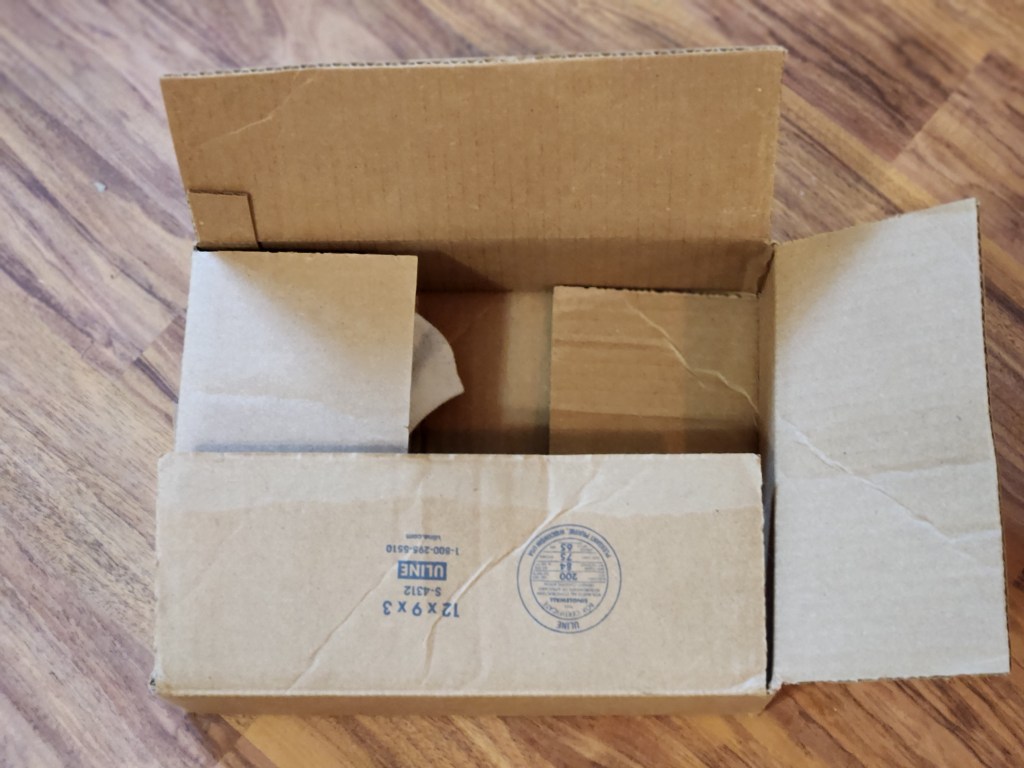
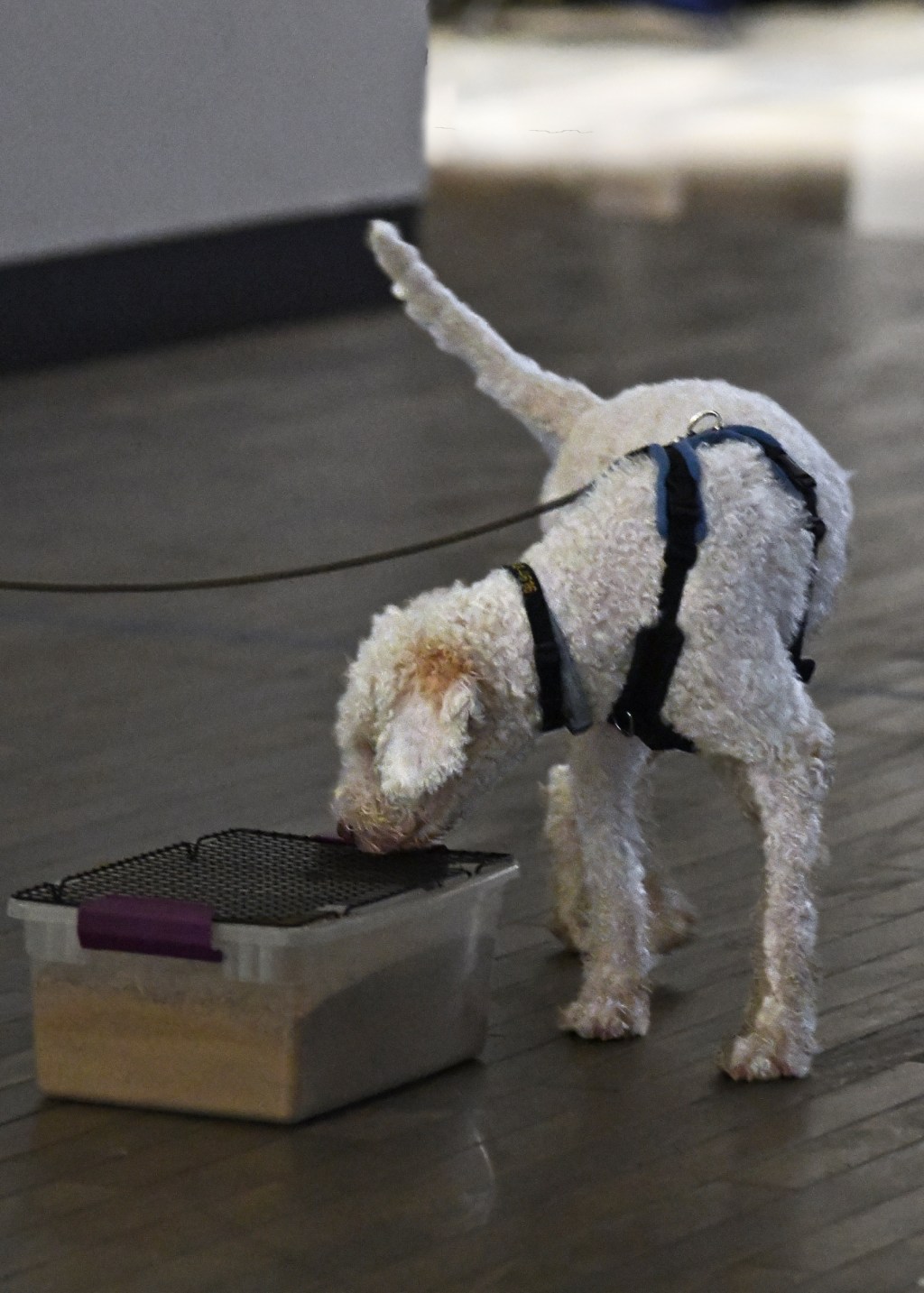
Somewhat accessible sock in a box
And the differences between the more accessible and the less accessible hides are radical for the dog. I remember my first nosework dog, Riley the chihuahua, who would work beautifully in exteriors if the odor was really accessible (like under a bench) but if it was contained at all (say, a partially closed box or and open fabric container of some kind) and therefore less accessible, he would often just give up. I have seen this reaction, over the years, with various dogs, and it seems to boil down to less accessible hides take a lot more effort than accessible hides (less odor=more effort). My beginner dogs all follow accessible odor willingly to the source hide. However, place that hide in a box, even a partially open one, and you will often see them shut down in confusion.
Like my friend’s dog with the scented sock.
The key to introducing inaccessible hides is to do it gradually, so that the dog learns how to work the airflow to the strongest point of concentration, which is as close as they can get to source. So, with boxes, I generally work them open, and then in stages, closing them very gradually. If the dog gets frustrated at all, I open them back up and start closing them again. With some dogs, when we are finally working closed boxes, and the dog accurately identifies the correct box, I will open up the box up and show them the source, before rewarding them. There is a visual component to finding a hide, and it helps many dogs to be able to see what it is they are looking for in the box.
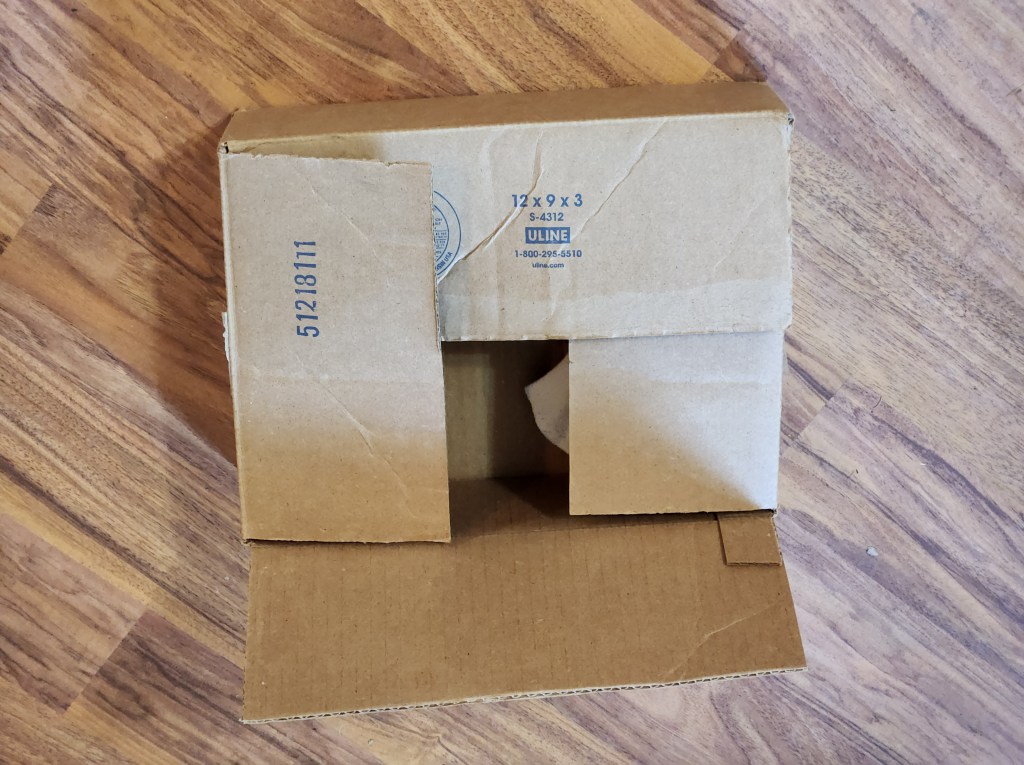
Less accessible sock in a box
I feel compelled to note here, that the HD element has some interesting challenges and complexities involved in it. The novice level is the main level where inaccessible hides are allowed. In Advanced and Excellent, the hides are required to be accessible, and no higher than 24 inches. In the Master level, you have two elements to work, and that can include boxes, so the inaccessible hide may make its reappearance.
There is a radical change in the amount of odor available from the Novice level to the advanced level, because the carrier of the odor is changed from a large item (sock or glove) with a lot of surface area, to a small item (the cotton ball) with a very small surface area. And, correspondingly, the AKC, in their wisdom, required the hides to be accessible and not high.
I don’t expect any training that I do in Novice to apply to Advanced, and while the jump from Advanced to Excellent is not quite as extreme, there is still quite a bit of training involved. And there is a huge jump from Excellent to the Master level, as now there is an unknown number of hides, as well as finding multiple targets and ignoring multiple distractor items. But, those levels are all topics for another day….
Want to get these posts delivered to your email? Click on the Home button on the left, scroll down to the bottom and put your email in the SUBSCRIBE box.
 Sniffing Around Scent Work
Leave a comment