Learning to Trust Your Dog, Part 2
In my last post, I talked about learning to trust your dog. Since then I have been giving it some thought. There are eight steps that I have been able to identify in learning to trust your dog. They are not really sequential, and can be done in any order. Here they are:
1. Let go of any preconceptions you have about how the search “should” go. Yes, we know you want your dog to search every container in order, or search the threshold first, then go to the left and get into that tricky corner. But your dog has to work his process. The odor from across the room may be hitting him in the face, and he needs to go get that hide NOW. Like many professionals, Astra has a particular process when working an area, and gets very flustered when I interfere, and I have learned that it is a bad idea. No one likes a micro manager (let’s face it, do you like it when people lean over your computer?) and that includes most dogs. Go do some meditation and let the search be what it is.
2. ESPECIALLY let go of your preconceptions about search boundaries and sequential searching. Those are human concepts that just don’t apply here. The odor doesn’t respect those boundary cones or the tape on the floor—it goes where it the air takes it. I have seen many a search team fail because the dog was following the odor cone, searching for the all-important edge of the cone, and then he goes OVER the search boundary and the handler immediately jerks him back. Now he has lost the odor, and sometimes has trouble finding it again, or he thinks the handler doesn’t want him looking for THAT odor, so he goes to look for something else.
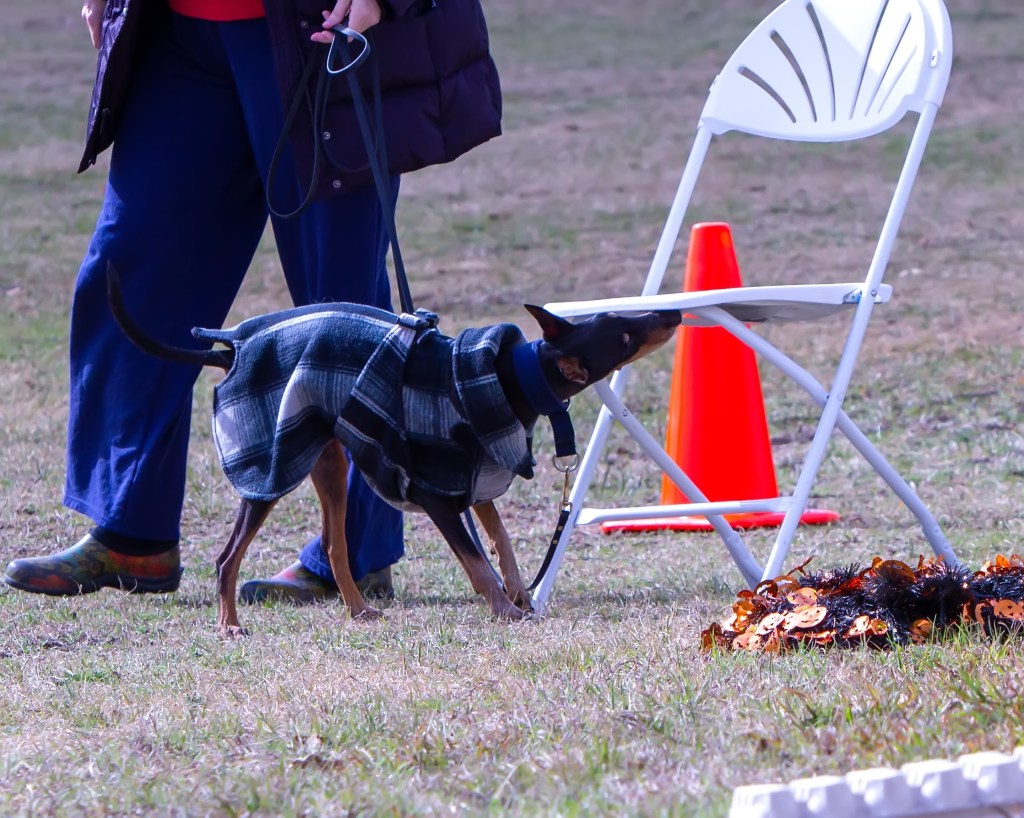
In particular, I remember an exterior search where I had placed the hide under a chair, near one of the search boundaries. At the time, there was a breeze blowing into the search area, towards the start line, and it was meant to be an easy hide. After a while, however, the wind picked up and changed direction, and was blowing the odor OUT of the search area, so that it was easier to find the hide if the dog went out of the area and worked the odor back to the chair. I watched a lab, a very talented dog, pick up the odor, and start looking for the edge of the cone, so he could follow it back to the source, he went past the search boundary. He was off leash, but he hadn’t put more than two paws past the boundary flags before the handler called him back very sharply. He lowered his head, turned around and came over to her. They never did find that hide, and didn’t qualify.
3. ASSUME that your dog is searching for odor, not a distraction. Unless you can actually see him going after a squirrel or whatever, or your dog is inexperienced, or has never been allowed to search independently.
4. Sharpen your observation skills. You need to learn another language, only this language has no words. This is the dogs’ search language, and it is a beautiful dance with the wind, the air currents, the scent molecules. Learning another language takes a lot of time and study, so be patient with yourself. Video, video, video, experiment, and and then video some more. Volunteer to time at a trial, so you can watch all the searches. Find some facebook posts and watch OTHER people’s videos. Take some notes. Draw diagrams. Ask questions of experienced people.
5. Learn about odor. How it moves. What affects it. Get a smoke gun, or a smudge stick, or some baby powder, and use that to make the air currents visible. We are a visual species, so we need to do this to figure it all out. Take a class in odor theory. Then use this information when watching your dog, and it will start to come together. The dance will start to make sense, instead of being just random movements.
6. DON’T depend on the final trained alert. The alert is a just one part of the picture, and using ONLY the alert to read your dog is like restricting yourself to using only one syllable words beginning with the letter B. Use ALL of the information available to you when on the hunt. The wind, the environment, possible hide areas, WHAT YOUR DOG is DOING. Good judges do this when saying yes or no. I was at a trial last weekend, and saw the judge give a “yes” to a dog who was a little distance from the hide when it alerted. There was a puff of wind just as the dog approached the hide, and the judge felt it and knew the dog was reacting to the amount of odor that it was blowing in the dogs face.
7. Understand that your dog is a living being, not a machine, and he makes mistakes. Particularly under the pressure of a trial situation. And that he is affected by your nerves, too. Be kind and understanding when he accidently alerts on a distraction, or has a bad day and doesn’t search well. Our dogs are so forgiving of our mistakes,
8. Understand that trust works both ways. Strive to be trustworthy of your dog. Be consistent as possible, and never stop learning your dog’s language.

 Sniffing Around Scent Work
Leave a comment