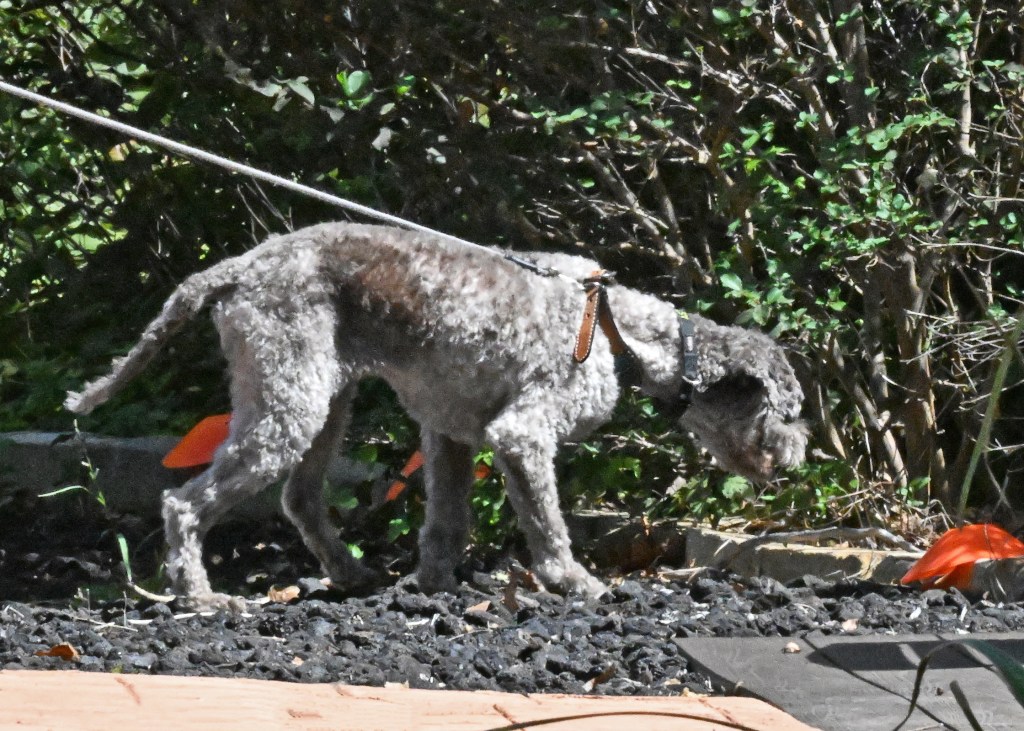
Learning to Read Your Dog
“Trust your dog”
“Read your dog”
“He told you about that hide four times!! Why didn’t you call it!”
These are things we hear all the time in scent work . As an instructor, these are things I SAY all the time. And yet we all still struggle with reading our dogs and calling the hides correctly. (I am still honing my skills, too). And I struggle to teach it. I have been reflecting on this problem recently, particularly in respect to teaching. I enjoy teaching, and I am continuing to look for ways to improve my methods.
Breaking it down for the students, it’s not enough to say “read your dog” over and over again. As a good trainer, I want to split it into finer pieces, so that the students are not overwhelmed. Once you have one small piece conquered, you can move to the next chunk, and the learning goes so much more smoothly.
I harp a lot on going out and volunteering at a trial, or at least, just go out and watch whatever searches you can (obviously, in classes you are not running, or once you have already run them. NACSW doesn’t allow this, but AKC and UKC and other venues do)
The problem is, people don’t want to do this. They feel weird, or they are involved in chatting with their friends in the crating area. And I get that. Trials are a big social event for many of us.
Mind you, I will continue to recommend this. Because if you watch the same run over and over again, you will see how consistently the dogs behave when faced with the same hide. You start to see some of the same signals that many of the dogs will give. You start to see the mistakes that the handlers are making (oh no! Do I do that??)
But I am also trying to break down “reading” to smaller chunks for my students in class. I have tried to ask them to identify just one small behavior that cues them into the fact that their dog is in odor. This has not been very successful, although most people can identify a still tail or the small movements that the head makes as the dog is honing in on the hide. But I have had trouble getting people to expand from that.
And in truth, when your dog is searching, it is hard to see things from above, in real time. Things are happening fast, and we only have one perspective (above the dog, or slightly to the side) AND we have to watch where we are going (and keep track of the hides, and keep track of how much time we are using up)
Video is the best way to go. You can stop and rewind and study, and have time to think. I once watched a video of Astra false alerting at a trial 14 times, trying to identify the problem. (The answer? I was inadvertently cueing the alert, moving my feet in a way that had, for her, predicted the reward a bunch of times. It was an important key to me observing and changing my behavior).
I have asked students to video their runs and then showed them on the big screen tv and talked about what I see when the dog is searching. This approach has had some results.
However, recently, I have had an epiphany about one important key that people seem to be missing: the dog actively searching for odor when they leave the start line. The dog is not just wandering aimlessly, the dog is working. (Caveat: I am talking about dogs that have been properly and consistently rewarded for finding a target odor. Haphazard or inconsistent training does not lead to good searching).
Handlers are often so mired in the past, when their dogs first started learning the game and were distracted, and so embedded in the mindset of knowing “better” than their dog, that they miss this: every change of direction is purposeful for the dog.
I am going to say it again: EVERY MOVEMENT, EVERY CHANGE OF DIRECTION IS PURPOSEFUL.
And if you watch the dog carefully, those movements and changes of direction will tell you where the odor cone is and where it isn’t. Because that is usually what the dog is doing: ruling out where odor is and where odor isn’t. Once you understand that one thing, you start to see other patterns. Mysteries are revealed.
I once had a judge tell me, when I asked about a missed hide, that my dog had nodded in that direction initially, before turning and moving in the direction of another hide.
Damnit, I thought, she NODDED??? I am supposed to notice that??? You better believe I watched that video a lot. The judge had been right. And I had not quite yet figured out that in an area with more than one hide Astra ALWAYS does a survey of the area before settling down and alerting. So I started to learn to look for those nods, and mark the places where they occur, so that I can remember to go back (because Astra doesn’t always remember).
Here is the video of that search. You can see her “nod” (actually, it is more of a stutter step) at second 9-10 of the video. There is a hide in the corner there (which you can’t see in the video), and she hits that odor, but she continues on the round of the room. On the second round, she misses that hide because she is drawn to the hide in the little closet across the room, the odor is clearly travelling down the wall there. We never did get back to that corner hide.
 Sniffing Around Scent Work
Leave a comment