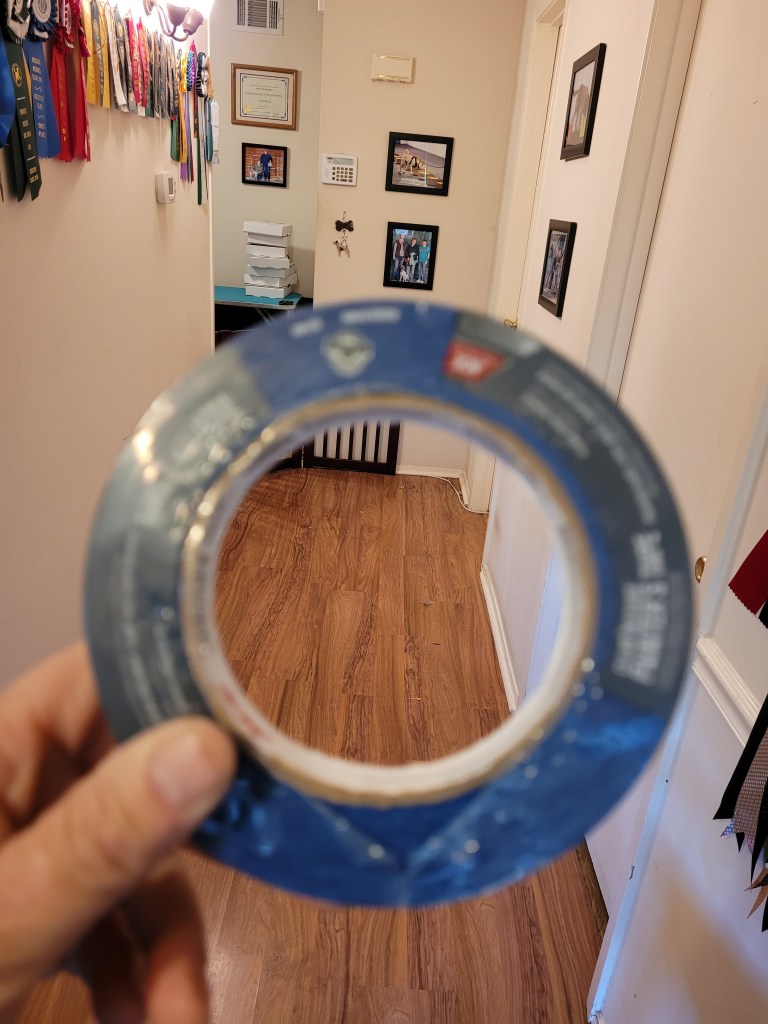
Ah the mysteries of nosework….they are myriad and they are everywhere.
On my mind recently has been the mystery of the blue tape. (Which sounds like a Nancy Drew mystery.)
This particular mystery occurs only in AKC trials (unlike the mystery of the disappearing hide, which happens EVERYWHERE) and stems from the fact that during a trial, areas may be re-used for classes.
The Scent Work Regulations state that:
Ch. 5 Section 6. Reuse of Search Areas. Search areas may be reused for multiple classes within a trial or trial weekend, but the same search area cannot be used for more than 7 interior, exterior, or detective hides during an entire set of trials. A set of trials is defined as scent work trials hosted at the same site within a period of 7 days.
Ch 5 Section 23. Residual and Lingering Odor. If search areas are reused during the course of the day, the judge must inform teams during the handler’s briefing (and may remind them on the start line) of the prior hide locations, to warn of possible residual or lingering odor. These areas must also be marked with stickers or tape.
In practice (at least in this area of the country), this usually results in areas being marked with blue painter’s tape, that being the most common tape found in a judge’s box (useful for marking boundaries, posting trial results, fastening hides to objects, etc.).
I have often, as a judge, timer, observer or competitor, seen dogs of all types and training backgrounds show a lot of interest in blue tape, sometimes alerting on the tape, and I have often wondered why.
The conventional answer to this question is the dogs are smelling the lingering odor left behind from the hide that was there previously. But this runs counter to my experience. I have seen, time and time again, in my own dogs, and in the dogs who run in my classes, that dogs (if taught and rewarded appropriately) clearly know the difference between source odor and lingering odor (if there is any lingering odor left after 24 hours).
I have seen dogs notice and dismiss lingering odor from as recent as a few minutes old.
(NOTE: definitions of lingering and residual odor are not used consistently in the scent sports world. I understand lingering odor to be odor left in the air after source has been completely removed. This is different from residual odor, which is when there is some tiny bit of residual source left behind on an object. In AKC, the q-tip with the oil on it is always placed in a vessel before it’s used, so that it never touches the object and no residual is left.)
I have generated several other theories as to why the dogs are so drawn to the blue tape:
1. Visually looks different
2. Is often used to attach hides so smell/sight of tape is a concurrent odor/object dogs are used to encountering with hides
3. Has absorbed some odor from being in the vicinity of oils/hides/source
4. Memory: the dogs remember where the hide was previously and since the tape is obviously a marker of some kind, they give it a lot of attention.
I personally favor theory number 4. I was once timing an exterior class where the previous day’s hide location, a bench, was marked with tape, per the regulations. Almost every dog went over to the taped area first and checked it thoroughly and expectantly. The judge and I wondered over this, neither of us felt that there could be any lingering odor left on that bench, as it had been over 24 hours since the hide had been removed.
We started asking, as the competitors left, whether they had run this class yesterday. Sure enough, most of the dogs who paid attention to that bench had run in that area before.
Many dogs have really good memories about where they have found hides. Cameron Ford, of K9s Talking Scents Discussion on Facebook, and Cameron Ford K9, runs clinics that tests how much detector dogs use their memories. I was in a webinar that Ford was giving and he told a story about how he was running drug dogs in a school where all of the classrooms were identical. They set a hide under a table in the first classroom, and in every room after that, the dogs went over and checked that same table before moving on to search the rest of the room.
And since that webinar I have noticed that most dogs will check the places that hides have been placed in previously. Which makes perfect sense…I mean, why wouldn’t they?
It occurred to me the other day that I have the perfect opportunity to do some testing on my theories. Since Yeti has not been trialing, he has not yet been exposed to the blue tape (I use quakehold to stick hides at home).
I got some brand new tape, fresh from the hardware store, so I could be sure of no contamination with any of the target odors, and I stuck some on the wall in the hallway, and then put a hide, down low, on the opposite side. I have not done any hides on that wall for a very long time—probably over a year. So Astra shouldn’t have any recent memory of a hide on that wall, and Yeti hasn’t yet found any hides on that wall.
I ran Yeti, and then Astra. Sure enough, Yeti noticed the tape, and investigated it, but didn’t look like he wanted to alert on it. He proceeded down the hall and found the hide. Astra, on the other, noticed it, and looked at me expectantly. It wasn’t an alert, (she sits for “final indication”), maybe more of a question. And then she worked the hide and alerted on it. There are videos below. (NOTE: the tape is actually not visible in the videos…sigh…I never said I was a good videographer)
Yeti:
https://youtube.com/shorts/-da3t8ezPTU?feature=share
So it would seem that both theories one and two would be confirmed with this little micro experiment. It is possible that all four of my theories are correct, depending on the dog, and of course, it is also possible that there are other reasons that dogs are interested in the tape markers at trials.
 Sniffing Around Scent Work
Leave a comment