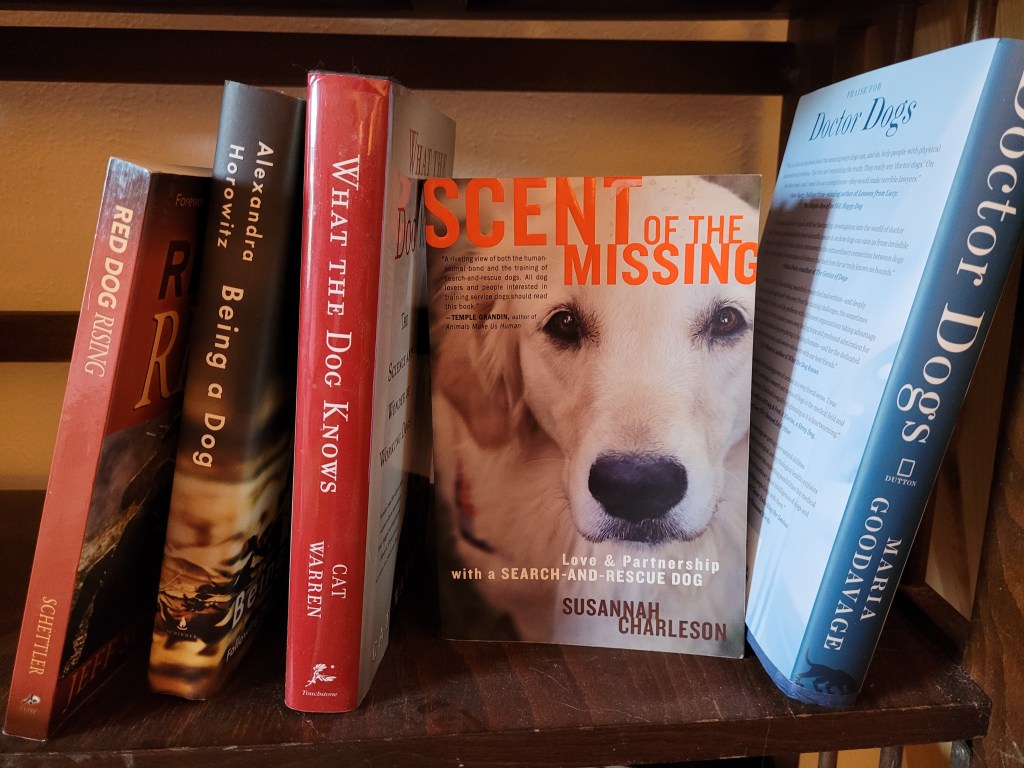
I am a librarian by training, and of course, am also an avid reader. I am always looking for books about my favorite hobby, and have developed quite a collection over the years, both in the “read for fun” category, and “read for instruction” category. I thought I would share a few of my favorite fun reads:
What the Dog Knows: Scent, Science and the Amazing Ways Dogs Perceive the World
by Cat Warren
What the Dog Knows is the story of Cat Warren and her cadaver dog Solo. Cat was an obedience competitor who ended up with a dog who was not suited to her hobby: a little too reactive, a little too energetic. She stumbled into cadaver detection work through a trainer she consulted. Cat trains alone, not as a part of a Search And Rescue team, and takes us along on her journey of discover through K9 training, running through swamps and cemeteries, encounters with the toughened police trainers. She is a college professor by trade and it shows, as sometimes her writing wanders into the academic obscurities of history, but overall this book is a very good read.
Scent of the Missing
by Susannah Charleson.
My absolute favorite scent-related leisure book. There is no doubt about it, I am in love with Susannah’s writing, it is very lyrical, and she is clearly driven by the passion of the hunt, and partnership with her Golden Retriever, Puzzle. Charleson is a pilot who was introduced to search and rescue by airplane, and joined a local volunteer SAR group. She gets a puppy to train as a search dog, and they grow and learn together. The book chronicles the training sessions, the camaraderie among the team, and some of the missing-person missions she went on, including working in the field after the Columbia went down.
I first read this book just after I started training my first dog for nosework competition (I can’t remember how I came across it) and I finished it in two days. Much of the subject matter was foreign to me; at the time I didn’t know anything about SAR dogs or SAR teams. Every year or so since, I have re-read it. As my knowledge of scent work and the world of professional sniffing dogs has deepened, I can appreciate the scenes and the stories of the book even more than the first time around.
Here is one of my favorite passages, where Charleson is describing Puzzle working on trailing a missing person:
…At the fifth apartment, Puzzle turns back the way she came. Though something provoked her interest here, she’s dismissed the area now, trotting out the driveway, and eastward again. At the intersection of the street we are on and a busy road bordering our sector, we turn south. There’s a moment’s pause. Puzzle pulls briefly eastward again, perhaps interested in crossing the major road that forms the edge of our sector. It’s a light tug from her rather than a hard urgent pull, as though she has a little scent she’d like to eliminate, but the busy road separates on city from another here. …after the slight tug of interest, Puzzle heads south again, then obediently turn west at the next intersection of streets for some indication that Jimmy [the missing person] has passed this way…..the cold front has thoroughly arrived; the wind is fitful and irregular around the fences and the boats, campers, and spare vehicles parked in the driveways. No uninterrupted scent cones here. I try to frame this environment as Puzzle experiences it: I imagine human scent sifting between houses, slamming into the sides of campers, and parting there to wind around each side or slip underneath it. I watch Puzzle raise her nose and circle slightly; maneuvering the odd spaces as she ferrets this human scent and that one, newer, and older, and oldest, and dismissing all of them as irrelevant. “
Being a Dog: Following the Dog into a World of Smell
By Alexandra Horowitz
This is one of the most thorough explorations of scent that I have read. Horowitz explores not only how your dog’s nose works and why, but also human scent perception and how it compares to a dog’s. Horowitz went on “smell tours” of New York City, participated in an olfaction experiment run by a lab, experiments herself with various tests.
She designed a test in which she asked the question: do dogs recognize their own scent (yes), but my favorite is the test she did in which she performed her own “handler discrimination” task. She had her son handle a book, and place it among other unhandled books on a shelf in her living room and then she tried to identify which one it was. She was successful, much to her surprise (“one book did smell more….warm blooded than the others”). One of the surprising conclusions that Horowitz comes to is that we have better olfactory senses than we are aware of –we are culturally dependent on sight rather than scent and most of us never develop our nose very much. In the last chapter the author recounts her experiences in taking a nosework class. All in all, a good read, well worth spending time on.
Red Dog Rising
By Jeff Schettler
This is a biographical account of a police dog’s bloodhound training, and accounts of various missions and cases worked on by his handler. Jeff Schettler wrote this book while recovering from an injury, from the notes he made while trailing criminals and missing persons with his first bloodhound. Schettler has a direct, homey style, and I love his honesty. Man trailing is the art of following the trail of a specific person, not just any person (which is often known as air-scenting or live-find in Search and Rescue). This is the passage which really made me fall in love with this book:
“I am guilty of producing a behavior in my dog during my early years that I see duplicated quite often, even among senior handlers. I was guilty of making my dog run what I call “ghost trails.” I define a ghost trail as an imaginary trail: no particular scent is being followed and the dog is simply running to please his handler…”
Those of us who compete in scent work can instantly recognize this problem: so many times we cause false alerts in our dogs because they are simply trying to please us.
Schettler chronicles his mistakes and failures as well as Red’s successes. He captures the thrill of the chase on the trail, as well as the gnawing uncertainty that plagues every dog handler. This kind of honesty, in my experience, is rare in the dog world. So many, many trainers and handlers only talk about the successes. Red was Schettler’s first bloodhound, and his first trailing dog, and his passion for this dog and the work that because his passion and his life shines through in this book. Schettler went on to train numerous bloodhounds and has become a world-famous trainer for trailing.
Doctor Dogs
By Maria Goodavage
Maria Goodavage is a journalist who got interested in working dogs and started writing about them extensively. Doctor Dogs is a thorough exploration of service dogs used all types of medical settings: predicting seizures, alerting to diabetic highs and lows, helping those suffering with PTSD, autism and depression, finding cancer in lab samples and people, and many, many more applications. She traveled the world, across all parts of the US, Europe, into Japan and Indonesia, to follow the stories of people and the dogs who help them navigate their days by helping with their disabilities, or diagnose diseases. The stories are told well, and immediately draw you in, whether she is writing about Brody, the seizure alert dog who also turned into a dog who could detect cancer in his owner, or Nimbus, the lab-golden mix who helps her owner with many health problems. Goodavage does tend to wander a bit in her narrative, and one does occasionally wonder if she is not just a little too gullible in believing the all of the details that she is told.
WHAT I AM READING NOW:
Truffle Hound (what else?) and Pit Bull The Battle Over an American Icon

 Sniffing Around Scent Work
Leave a comment